I was hoping to see the famous story of path dependency that traces the dimensions of shuttles back through the history of rail gauges back to Roman chariots and the width of two horses
http://www.astrodigital.org/space/stshorse.html
The video at the end of the article is absolutely fascinating.
Also, it's the first time I hear that rejecting heat is a big deal in space. If anything, I would have assumed that heating the station would have been a problem, rather than keeping it cold.
Indeed, whenever corp-mates would ask why there are brightly lit "windows" on their ships I would point out that they were actually heat dissipation panels.
Thank you. TIL, actually not learned realized, space is actually a good insulator out of earth conditions too. Prejudices. We can never know what if something we thing is a reality or prejudice. Science and skepticism is that important.
Also of note is that while a vacuum doesn't necessarily have a temperature (it's just a medium), space does.
Even if you go far away from anything else, you will still reach thermal equilibrium at the Cosmic microwave background (CMB) temperature, which is 2.7K -- it's essentially the "temperature of the universe", radiation which has been emitted as far back as the first moments of the universe.
And of course, if you create a vacuum chamber on Earth, any object inside will always reach equilibrium at ambient temperature (in the lack of any heat engines on the body -- even then the fuel would deplete some time).
Technically interplanetary space is a hot plasma too. The particles emitted by the Sun are very hot according to kinetic theory (which only depends on the mean velocity of particles) since they have a lot of energy. It's a plasma because the particles are charged and accelerated by the Sun's magnetic field.
Of course the density of these particles is very low, so if your definition of heat factors those in then space is cold.
My understanding is that the spacecraft was designed to radiate large amounts of heat, with the expectation that systems inside the spacecraft would be producing a lot of it. Apollo 13 shut down much of the equipment inside the spacecraft, which meant that it was no longer producing as much heat as was expected.
It would with an unlimited supply of coolant, but bringing mass is expensive. Unless you start grabbing asteroids and using your waste heat to vaporize them or something....
so my stupid question is, cannot it be used for power? Surely the same system which radiates the heat can be exploited to generate power with something akin to a sterling engine.
A heat engine is great when your cold sink is 'free', but here, the cold sink would be the radiator fins, and extracting energy from the temperature difference between main ISS and radiator fins would effectively just make the radiator fins worse at cooling the ISS.
Which is fine if you have lots of excess radiator fins. But they almost certainly don't -- shipping up extra radiator fins in order to get power from the excess cooling capacity would be less efficient than just adding solar cells (efficiency of a heat engine maxes out at 1 - (T_cold / T_hot)).
These radiators exist specifically to deal with power which has already been used. As stated in the article, the station needs a few kW of electrical power. Eventually all this power ends up as a waste heat energy. There is nothing that can be done with it, so it has to be dumped into space.
There's also solar heating of the station itself to worry about. Although to some extent you can make the station reflective (white) to deal with that.
Space is pretty much a perfect storm. As if relying only on radiating heat were not enough, you need gravity (or some acceleration) for convection to work. And then simply pumping a fluid through tubes is an interesting issue when the fluid does not know which way is down.
Hmm. That made me wonder about Apollo 13, where the "crew endured temperatures at or below freezing for the bulk of the return flight" [1], apparently [2] because they had to turn off heaters and electronic gear to conserve power.
The fact they had heaters suggests that the roll wasn't so much to dump heat as to spread it around, to reduce the risk of structural damage from differential heating [3]. That's presumably less viable on a big structure like the ISS.
One factor in the shape of the station that's not commonly known is actually aerodynamics. The ISS is in a rather low orbit (mostly to make getting there easier) so aerodynamic drag is a noticeable (if small) force.
The station is thus laid out kind of "flat" to present a reasonably compact frontal area. (This also helps with orbital debris encounters.) The solar array positioning does commonly conflict with the aerodynamics, but minimizing that is one of the factors in their positioning software.
Laying the panels 'flat' with regards to the orbit saves significant amounts of fuel. There's also a mode where they do the same during the day if there's a critical shortage of fuel.
I'm wondering about rotation and trajectory. Do they have engines on the craft to maintain its trajectory? But then if they thrust from one module, given all modules aren't aligned with each other, that implies thurst creates a rotation of the craft, so do they have two engines for each dimension?
Same question for solar panels: Do they let them rotate so at odd times they're exactly flat in the plane of the sun and receiving 0% energy, or do they rotate other modules of the spacecraft so that the solar panels are always at the sun?
I know NASa had a competition running for the public to see if anyone could find a more optimum way of rotating the solar arrays on the station to improve power.
They detailed some crazy restrictions like how the panels have to be heated evenly so the thermal expansion does not rip them apart.
> Same question for solar panels: Do they let them rotate so at odd times they're exactly flat in the plane of the sun and receiving 0% energy, or do they rotate other modules of the spacecraft so that the solar panels are always at the sun?
I think I didn't quite get this question.
The solar panels have two rotary joints; the alpha joint (https://en.wikipedia.org/wiki/Integrated_Truss_Structure#Sol...) and the beta joint (related to the beta angle, see https://en.wikipedia.org/wiki/Beta_angle). With both joints operating together, I think there's no angle where the solar panels can't be pointed directly at the sun. They only get out of the sun when it's behind the Earth, or if they have to move the panels out of the way to avoid pluming from a docking or leaving spacecraft.
I think they mainly use the Soyuz to maintain the altitude. If you point the engines so that you apply the force as close as possible to the center of mass, you won't get much rotation.
When computers started they were beige boxes, now they are decorated and colorful - so we know they are done.
People worry about how phones look, so those are done.
The first smart watches were functional, now they worry more about aesthetics, but none are actually on the market. So that technology is not done, but is getting close.
Cars have been all about aesthetics for decades now.
Etc, etc.
(Don't assume "complete" means they don't improve them, it just means any further changes are minor, and mostly unimportant.)
Airplanes for example seem like they are done - but they are not sold on looks, so they are not actually done. (Maybe a little bit on the inside?)
Disagree strongly. Computers are way uglier now than they were in the 90s (beige boxes).
There is an arc in every art. It starts with the bare bone essentials, exposing the spirit and greatness. Then it becomes popular and amasses cruft until its unbearably overloaded and ugly. Then it gets stripped back to its original form, regaining its glory. And then we repeat.
Agreed. I started noticing 5 years ago that laptops started getting really... I don't know, tacky? Not to mention the dozens of stickers that no one thinks to peel off.
Also, anything marketed towards gamers tends to look like it has enough pieces and glow so much that it might be mistaken for a nuclear reactor.
Depends on the manufacturer, of course. Apple's laptop visual design over the last decade or so has been basically conservative, but you can really see the improvement from the original MacBook Pro from 2006:
Today's MacBook Pros look quite similar to that one (aside from being much thinner), but the light has been dropped, the power button has moved to the keyboard, and the "MacBook Pro" branding below the screen has been removed, resulting in a slightly cleaner look.
The new MacBook is a more dramatic change: it will bring the branding back, offer three metal colors, and cram the keyboard into the body in a way that looks slightly awkward to me, but has the obvious advantage of minimizing the physical size of the device. Time will tell how well its design holds up.
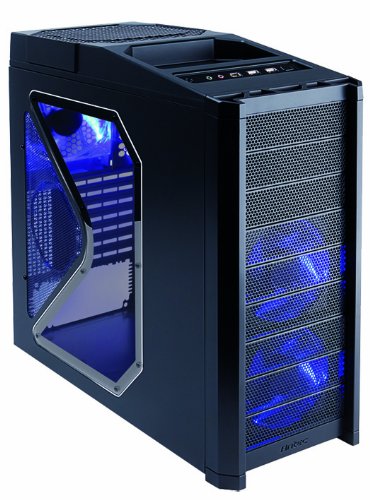
At first I thought it looked great, until I realized it was loud, dusty, poorly designed for airflow and wire management, and annoyingly bright at night. This case was a Civic with ground lighting and a huge spoiler. The new case is more like a Tesla.
Aesthetics are hardly a fixed point, though. And I could argue for the high point of aircraft aesthetics being in the past as the #1 criterion is cost now. For example, Concorde. (For military aircraft aesthetics I'd pick the EE Lightning, the Avro Vulcan, and the B-2, the iPhone of bombers).
Arguably car aesthetics peaked in the past too - perhaps in the 1960s (e.g. Jaguar E-type). Certainly it is somewhat a matter of taste, but modern car designers also have restrictions that older ones didn't, such as pedestrian safety requirements.
I think it's only partially true. Technology products may get pretty depending on who is the consumer. Computers, phones and cars get nice exterior design, because the "general public" uses them, and they are, as you said, sold on looks.
But consider industrial machines and buildings: mining machinery, electronics assembly lines, car factories and oil mining platforms. No matter how mature an industry branch is, machines are not being built to look nice. And warehouse buildings are just huge, gray, ugly-as-hell boxes. This is because there are many other constraints, machinery gets expensive, and there's simply no use for aesthetics.
So I think that spaceships may get nice exterior design if a lot of people (think millions) is going to be buying them. If the consumer group will be small, we will get aesthetics closer to cargo trains. Which, in my opinion, is awesome anyway.
And yes, I too think that ISS looks great as it is.
Most industrial machines have reached a point of utility that there has to be a way to signal "this is the new one" because we are wired to think that "new" means "better".
Some of the frontloader's sleekness is aesthetic, but it's also more functional, with a better view for the driver and no distracting bars in his front FOV.
After flying a few of the newer Airbuses, I can tell you that now when I search for a flight I look what kind of plane is flying, and if there is the chance to fly those, I gladly pay the difference. Not sure in USA, but here in Europe we have a solid mix of Airbuses and Boings so there is plenty to choose from.
The flat screens are better and I think there were power plugs, the first I've seen so far. I'm not the biggest fan of the electronically dimmed windows since you can't make it completely opaque. Other than that no big changes as far as I remember.
flew on one of these a few times and the flat screens were shit. constant issues with touch sensitivity and responsiveness. on one flight the screen kept having random phantom touch inputs, which was an issue because I was trying to sleep and it kept waking me up. I had to tape the inflight magazine over it.
Not sure why you're being downvoted, I had exactly the same issue with the screen powering up in the middle of the night due to phantom touch inputs as well.
I had the same issue with the flat-screens on a 777-300ER. It was especially annoying because my wife and I were flying with our two young children and it kept waking them up.
The flat screens are airline dependent. They were fantastic on Norwegian.
Overall I'm a fan of the Dreamliner (only 2 flights, a roundtrip on Norwegian). Seats were reasonably comfortable, even for economy on a budget airline. The big windows are nice. It was definitely quieter and (placebo?) the air did feel less gross.
Downsides: The arm rest didn't fully rise out of the way, so it's no good for sleeping on your partner's shoulder. The not-fully-dimming windows were a little annoying, but also really neat.
No, that would mean they were allocated too much money. Too much money in a government agency is immediately consumed by bureaucracy and waste. NASA isn't paid to make pretty crap, they get paid to do really awesome research and push the boundaries of engineering and our knowledge of science.
Hmm, that is a very good point. Still, I look forward to the day when our ability to explore space gets far enough for focusing on aesthetics and making pretty crap to not be something unreasonable.
Are solar array almost like a film? I thought they sort of folded but in the animation they look like they can almost roll them up (I know it's just an animation, but it left me wondering).
They are rigid solar panels mounted on Kapton tape. There's a fan-fold mechanism to store them for transport - exactly like old tractor-feed printer paper.
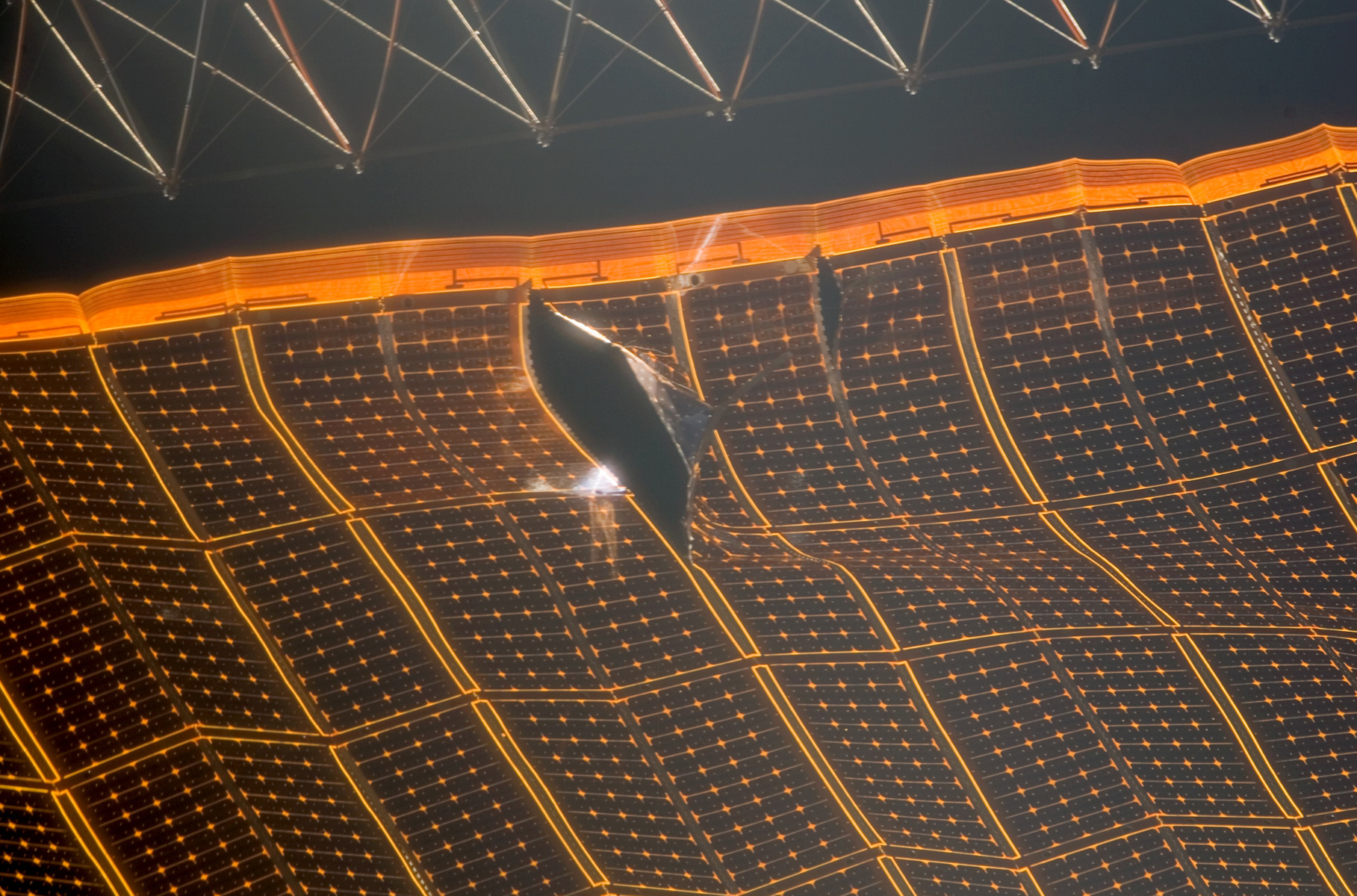
They can fold them back up, and they are an in-space replaceable component but there's no reason to ever do that. It was done once to move the P6 truss from a temporary position on top of the station to the end of the wing, but this resulted in (repairable) damage to the solar array.
I'm guessing it refers to the problem when docking the shuttle or other spacecraft of making sure that thruster exhaust is never directed towards the station itself. I remember seeing a video that showed the shuttle approaching the station on a nautilus-shell sort of trajectory, so that thruster fire was always directed out and away from the station.
Apart from the obvious danger of impact from ice and other debris from thrusters, unburnt hydrazine is nasty stuff- you don't want to deposit any on the station, only to have an astronaut on EVA scrape some off by accident and bring it back inside.
First thing that popped into my head was "This might be an article about why we don't have a Rotating Wheel space station" (mostly cost and ability to transport the necessary parts into orbit, and some other technical details).
The article itself explains the layout of the ISS nicely though.
I'd still like to see the construction of a rotating wheel station some day ;)
A little bit of me would like to see that animation at the end with RTS like stats changing with regards to resource capacity,use and the cost going up.
I see they added a solar array whilst for a period closing the one on top of the station. I wonder if they had to make do for a period or the new array was much improved it didn't matter much.
Oh, but it does. Parts and components usually aren't very space-efficient, specially when shipped together with other parts. Look at any toolbox, there is a lot of wasted empty space.
Instead, you'd ship a lump of whatever material is required by your printer, and manufacture whatever is needed, on demand.
It's more compact and more versatile, what's not to like? Weight is at a premium when you are talking about payloads, but so is space.
You could also, in theory, use the non-fuel part of the rocket stage that brought you up for building material. Some people have actually proposed using empty fuel tanks for living space but this would be better.
Vibrations are a constant worry for the ISS. The structure is pretty stiff - each module is connected with a series of bolts (20 I think) and very stiff steel rings.
One of the long term fatigue problems they have to worry about is the impact of space ship docking - the existing APAS-95 docking ports require a significant force to initiate mating which causes the whole structure to flex, especially the truss as it's perpendicular to most docking ports.
NASA are planning to solve this with the low impact docking system (LIDS), but that's not going to be deployed until the Orion capsule flies, or perhaps the SpaceX crewed Dragon.
Day-to-day all the exercise stations are mounted on special vibration reducing mounts, even the treadmill. Back in the Space Shuttle days there would be blackout periods for exercise to reduce the vibrations transmitted through the docking port to the shuttle.
This is actually a straightforward question to answer, I think:
By conservation of momentum, the center of gravity of the entire ISS + astronaut system needs to stay on the same path before and after your wall bounce. So, the momentum change for the ISS is equal in magnitude but opposite in direction to the momentum change for the astronaut, and the velocity change will be the velocity change for the astronaut times astronaut mass/ISS mass
Getting actual numbers to plug in left as an exercise for the reader.
That doesn't tell you whether you will start the station oscillating in some mode of vibration. For that you'd need a model of the stiffness and structure of the station.
The sky is cold, the Earth is warm, and the Sun is hot. If you have heat you want to get rid of (and in a spacecraft you usually do, since vacuum is a great insulator), you put it into a panel with good heat radiation characteristics and point it at the sky, and arrange shades so it can't see the Earth and (especially) the Sun.
The panel then being hotter than the sky, it sheds heat off into the universe, cooling itself, and the spacecraft.
This is why you will usually see solar panels and radiator panels perpendicular to each other. The solar panels want to see the sun, the radiators don't.
Thermal radiation is an order of magnitude less efficient than other forms of heat transfer, but it gets the job done. It helps that you're radiating to the dead of space, which is near absolute zero (efficiency is dependent on the black-body temperature of what you're radiating "to").
That's the why the radiators have to be so huge, and are kept out of direct sunlight.
I always wondered why real-life space stations don't seem to have the sleek exteriors, pleasing or even consistent patterns, but seem to have a bunch of irregularities, and ugly-looking metal structures of different shades of beige protruding from the hull. How do you explain that?
The reason to have sleek exteriors or to look cool is because you need be aerodynamic (because you're in the air) or need to look cool (because you're in a movie, or you're a consumer good).
Being neither in much air nor in a movie nor a consumer good, real spacecraft don't bother with expensive, constrictive, and (more importantly) heavy exterior shells. Instead, form follows function.
- no aerodynamic concerns
- extreme weight concerns for launch
- each component is a one-off custom module
- it's a life support and research vessel
- a smooth cover would make it harder to work on components during space walks
1) Convection, i.e.: the mixing of bits of 'hot' material and 'cold' material such as the material itself mixes through. Think blowing an air conditioner in a room.
2) Conduction, i.e.: the flow of heat energy through matter that is touching. The matter itself doesn't mix, but the heat energy can transfer. Think putting your hand on a hot plate.
3) Radiation, i.e.: the energy turning into electromagnetic radiation and beaming through the vacuum of space until it strikes something. Think sunlight.
1 and 2 are out, as there's no matter (air, etc.) around the ISS for it to convect or conduct with. Thus, all heat must be radiated. The above list ranks them in order of efficiency, so heat rejection is in fact very difficult.
mmh... interesting problem. I wonder if satelites could just put the heat in some not-more-needed stuff, gas or something and simply shoot or launch this stuff to the space.
Yes I'm inventing the "farting satellite" :-).
Another possibility could be to put "hair" (short metallic spikes) about lets say the 50% of the surfaces of the satellite. Several possible goals could be achieved with this idea, creating lots of dynamic shadows around the surface, protecting the real surface from small impacts (some bend spikes is better that having a hole in your roof, and maybe even to provide support to the ocassional human intervention out (you could substitute the spikes by a matrix of handles easy to grasp).
Just some crazy ideas. If you need to loose heat look at how birds and mammals do this task with movile hairs and feathers.
> I wonder if satelites could just put the heat in some not-more-needed stuff, gas or something and simply shoot or launch this stuff to the space.
The astronauts actually did that on the moon! Their spacesuits used sublimation of water ice for cooling.
Your limitation is coolant mass. The useful life of satellites is often linked to the amount of propellant they have left; you'd have the same problem with your proposed cooling system.
Wow, you need ice to take a walk in the cold moon? this is one of those smart tricks that we, common people, never, ever will suspect :-)
okay so... so the goal is to be able to cool quickly our station in case of emergency. We had running out of coolant gasses and so and we have "unlimited" access to the materials in the space: "nothing" and sun radiation.
I wonder if there is a way to reduce the vibration of heated atoms with electricity, magnetic fields or whatever electronics can do?
Temperature is more like "undefined" in a vacuum, since heat is the motion of matter and there isn't matter in a vacuum. Vacuum is a good insulator, which is why a Thermos is an effective storage vessel.
I don't think it's really fair to say there's no way to define a temperature in a vacuum. With radiation, it seems fair to call the temperature that to which a black body would be heated if placed in the vacuum.
Outer space is very, very far from thermal equilibrium. The temperature of the interplanetary plasma is different from the temperature of the redshifted-big-bang-light (CMB) which is different from the temperature of sunlight. The temperature of a black body depends on how much of it is exposed to sunlight vs. CMB.
I'm well aware, but I was just talking about the easiest case (deep intergalactic space with the CMB and minimal other exposure to radiation). There's a lot more complication than that, as you indicated, but I still don't think it's fair to call it undefined due to the lack of matter (I'd grant calling it undefined in some areas due to the complication of the different sources of radiation and of the matter, but that's another story).
Losing heat is the principle design issue for satellites. Easy to gain it -sunshine, power generation, circuits. Losing it requires deliberate effort, and radiation is your only pathway.
Heat conduction is very poor; you're practically in a vacuum, so you can only lose heat by radiating it.
On earth, you can dump your heat into the atmosphere or the oceans, which are both gigantic heat sinks. The entire surface of the earth then radiates that heat out to space. In space, you only have your own surface to radiate the heat out.