The approximately 1600MHz signals emitted from a gps satellite are generally aimed directly down at the earth at any given time, but with a good enough receiver and directional gain antenna on the moon you certainly could pick them up.
I also have a theory this might work because at any given point in time, some of the gps satellites while moving at their orbital altitudes might be emitting signals aimed somewhat more directly towards the moon, at least for short periods of time.
"The use of GPS signals for spacecraft navigation has increased in general over the last few decades. Navigation employing GPS observations for spacecraft in low-Earth orbit is now considered routine.
"However, the situation is quite different for spacecraft that fly in the Space Service Volume above the GPS constellation, including medium-Earth orbit (MEO), geostationary orbit (GEO) and high-Earth orbit (HEO) satellites, as well as missions to the Moon and beyond.
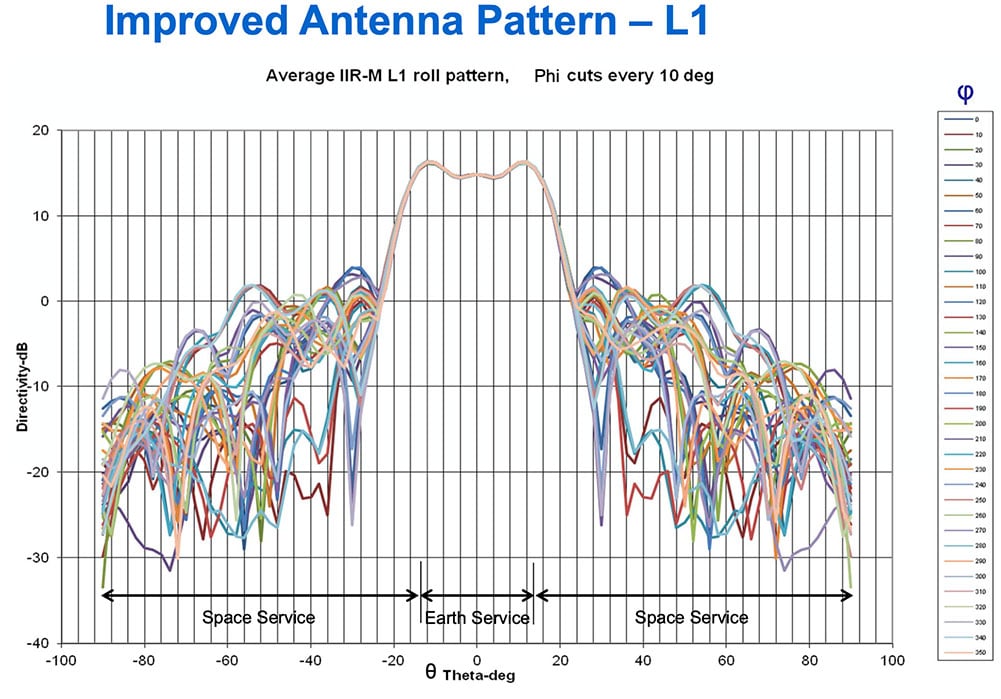
"For these spacecraft, reception of GPS transmit antenna side lobe signals is essential to improve availability and performance of on-board navigation and timing. In this context, the knowledge of the full antenna pattern (main lobe and side lobes) from the transmitting antennas of each of the GPS satellites is essential."
So the signal is strongest between GPS satellite and the Earth, but the beam doesn't have sharp edges and enough of it misses the earth to be useful in higher orbits, even above the GPS constellation..
A good part of that would be because GPS satellites orbit considerably higher than all LEO stuff, at approx 20,000 km, so everything in low earth orbit is almost equally as blanketed in valid GPS signal as things at 0 meters MSL on the ground on a beach.
Something orbiting at 550 km is approx 0.027 of the total orbital altitude of a 20,200 km orbit NAVSTAR series GPS satellite.
Sidelobes aren't really 'soft edges' to a main beam, they're unintended peaks at angles outside the main beam which sap gain. You can see peaks here around 29, 55 and 68 degrees:
As such, successive GPS satellite antenna designs have been refined to reduce sidelobes, just as deep-space operators have realised they could be useful.
TLDR: sidelobes aren't like gentle feathering at the edges of a beam, they're more like petals of a daisy.


I also have a theory this might work because at any given point in time, some of the gps satellites while moving at their orbital altitudes might be emitting signals aimed somewhat more directly towards the moon, at least for short periods of time.