SpaceX's effort to take first-stage reuse from moonshot to mundane is nothing short of extraordinary. It still makes me smile to think of how breathlessly excited we got over individual frames of grainy footage from the first water landing tests. The fact that landing and reuse now seem routine gives me a high degree of confidence that they will succeed in future endeavors - landing a Starship seemed inevitable, rather than the stuff of sci-fi dreams that it was only a few years ago.
When they were talking about the Starship launch the other day, it hit home for me how much more practical knowledge you can learn about your device when it survives use and you can disassemble it to study. Especially in these days where a device that can analyze metal for microscopic cracks is cheap enough that every airline maintenance hub has one on hand.
This fact essentially, and I think somewhat ironically, makes single use rockets harder to do design iteration on than ones meant to last for years.
Presumably the newest rockets will have higher thrust to weight ratios, or lower risk of failure, so the older ones will be priced as the cheap seats for as long as they last and the opportunity costs aren’t too high. Then they’ll either be parted out or put on display - land an EOL stage at every new spaceport and put that out front as a billboard.
> makes single use rockets harder to do design iteration on than ones meant to last for years.
This is why they do so many tests on components, then subsystems, then on real flight hardware for a very long time before they attempt to fly: because once it leaves the pad, they'll never see it again.
Agreed. I barely knew who Elon Musk was until reading his biography, which was written years ago. The biography ended with Elon's dream of colonizing Mars and doing verticle rocket landings, and talked about the challenges and shared some skepticism. So from my perspective the first of his "dreams" has become a common reality, and I'm left thinking that colonizing Mars is next.
EVs are impractical. Charging fast can't be done and the network won't exist until the cars get built anyway. But noone would buy them without the network so its impossible.
Oh, you built EVs, 100KW+ chargers and the network yourself? Well, obviously that was inevitable if we had just given General Motors and Ford enough time.
Its not a falsifiable position, so its interesting to think about too.
Electric cars and vertical rocket landings were ideas you could show would work eventually with a little napkin math. It is a good critique of humanity that so many "experts" neglected to do that napkin math and just declare it impossible.
Getting starship to work reliably still involves some never done before procedures that remain to be proven. But SpaceX has a plan that might work, if it doesn't there are many ways to adjust the plan. With enough time and money, they can do it.
Colonizing mars is not so easy to show as feasible. Certainly we can launch a bunch of cans and digging equipment and get a few people living there. But anything like a self sustaining population? Don't know, we don't really have a concrete plan of how to do that. People often say, if you think you can colonize mars, colonize the Gobi Desert first, as it is 10,000 times easier.
It makes much more sence to industrialise the Moon than to colonise mars. Moon materials can be used to produce ships and space structures, satellites, propellant, etc. You can have a space elevator on the moon today with a titanium cable. It will actually be profitable.
Most importantly, colonising the moon is tractable in terms of emergencies: if someone on the moon suffers an accident and needs a surgery, they could be in a hospital on Earth in a day or two. If their shelter is damaged, or supplies are needed, we can send help to the Moon and have it arrrive before everyone is dead.
You are on mars and suddenly are suffering from liver disease? You are probably dead. It's going to be like the life of iur first Abtarctic explorers, when they get in trouble, there is no help. Many don't return, and noone stays there to live. To this day noone 'colonised' Antarctica.
Mars settlement is only viable when we have a spaceship factory on the moon, nuclear engines, and we could send the equivant of a large marine research vessel to mars, so 10,000 tons usefull payload, every month.
The moon has some additional practical hurdles compared to Mars:
1. No atmosphere means no weathering, so all of the moon dust is incredibly sharp and easily coats equipment when it gets kicked up. This dust quickly wears out joints and contact surfaces.
2. The Moon's low gravity and lack of atmosphere mean that you have to carry extra propellant to land.
3. Lack of easily extractable resources. It is comparatively easier to extract water and CO2 on Mars to generate methane for a return trip. A trip to the moon requires carrying all of the fuel for a return trip as well.
Nuclear-powered ships built in orbit would drop transit times significantly but I wonder if they'd significantly reduce Mars <-> Earth costs (you'd still need Starships to shuttle payloads through the atmosphere). They are probably required for mining the asteroid belt though...
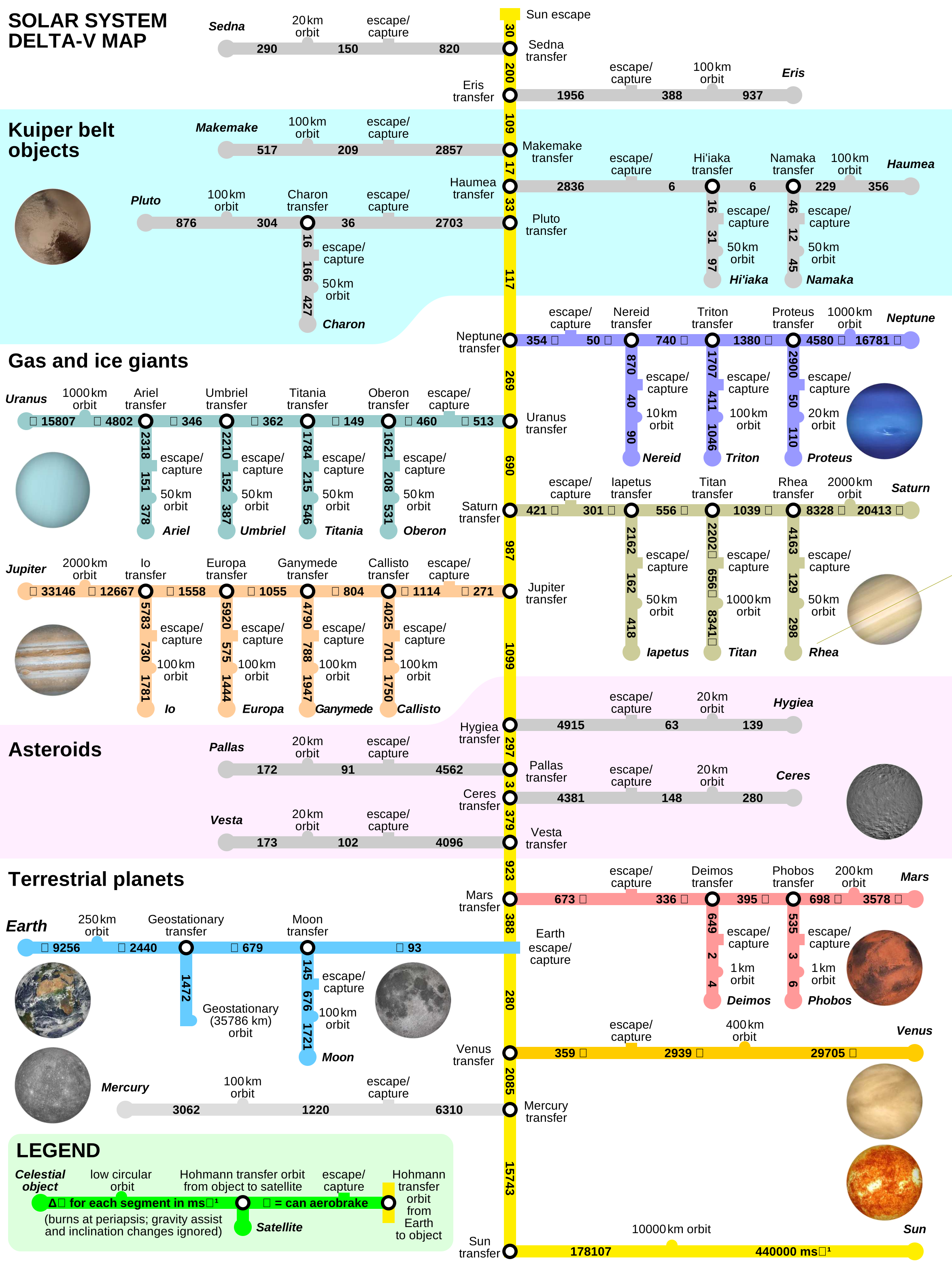
Sorry, my first thought was that it requires more delta-v to enter a lunar capture orbit since the gravity is weak, but I just double checked the delta-v roadmap and it's actually not that high.
However, it is a bit problematic that landing a rocket on the lunar surface can kick rocks around the planet (thanks to the low gravity), possibly into orbit or beyond (which could pelt other equipment). So you need to switch to an entirely different propulsion system for descent, which carries a payload penalty.
Mars is considered to be the hardest planet to land on in the entire solar system, you have to carry a heatshield or you will burn to a crisp, but it's so thin you still have to land propulsively using rockets. You definitely need to sacrifice less spacecraft mass to land on the moon
Also there is some water on the moon so you can make rocket fuel, though how much exactly remains an open question
> Mars is considered to be the hardest planet to land on in the entire solar system
Questionable.
> but it's so thin you still have to land propulsively using rockets
You have to do the same on earth. Starship sized vehicles have to land on earth propulsively too.
Sure, you can do somewhat larger payloads to Orbit without engines but for large things you need to have real engines.
> You definitely need to sacrifice less spacecraft mass to land on the moon
On the moon you can't aerobrake, that is far worse.
> Also there is some water on the moon so you can make rocket fuel, though how much exactly remains an open question
There is a huge difference. Water on the moon has to be mined from permanently shadowed craters. The water is frozen and incredibly hard, its more like mining stone on earth.
On Mars there are places where you can literally land, drill down and make yourself an underground lake pretty easily. Or land basically right on an ice sheet.
On the moon you need to figure out how to get energy down into the crater, you need sophisticated mining equipment, all that equipment needs to handle incredibly low temperatures.
Mars comparatively is not so far away from earth in terms of temperature for your equipment.
In summation, in-situ for rocket fuel/water is far, far easier on Mars.
Tests have shown then depending on the situation lunar regolith can go up 80MPa. And the more water is contained, the harder it gets. You get low yield from that, around 10%. So you need to mine a pretty large amount and process it.
So you need to create excavator that operate inside a creator that can operate at extrem temperatures.
On Mars you can literally do what we already do at the South Pole, drill a hole and make it warm.
Water yes, but I haven't seen anything about CO2 so I think you're stuck with hydrogen-oxygen engines (which have different tradeoffs than methane-oxygen engines).
There is a lot of oxygen on the Moon (combined with silicon and aluminum), but carbon is not readily available, so it'd be more favorable to hydrolox engines.
Mars has a few things in its favor. It has a (mostly) carbon-dioxide atmosphere that can be used as an ingredient to make methane. It has a normal day/night cycle so you can use solar panels without needing to store two weeks worth of energy in order to last through the night. It has higher gravity. In general, it's just a more hospitable place to live even though it's a lot further away.
We could start on Mars by building stuff in the canyons first at the lowest possible elevation to increase the air pressure. Then you can dome sections of the canyon and pump up the atmosphere allowing large "outdoor" area.
Mars air pressure is really low; I don't think building in canyons would have much benefit if you're concerned about reducing the stress of air pressure on the habitat. Building low relative to the surrounding ground though might have benefits related to radiation shielding, though.
The way I usually picture Mars settlements being made is either finding an existing lava tube and creating an airtight seal on the interior, or digging a hole in the ground, erecting a dome (possibly out of blocks made on-site from local materials), and then burying it in dirt. The dome acts as a compressive structure, and you can inflate a habitat on the inside like blowing up a balloon. Either way, people live underground for the benefit of radiation shielding. And either way, the airtight seal of the habitat has something solid for all that air pressure to press against.
I know that it's 1/200th of earth sea level but based on how deep those canyons are you might get 1/20 at the deepest parts. Maybe enough for water to not immediately evaporate.
Reminds me of Out of the Silent Planet by C. S. Lewis, written before anyone had much of a clear idea of what the surface of Mars is really like. There was air and life in the canyons, but everything else was a low-oxygen desert.
Realistically, though, I wouldn't expect pressure to vary that much with elevation. Mars' weaker gravity implies that it would vary less than on Earth. However, according to this [1], the pressure does vary a lot by season. That's interesting.
> Surface pressure: 6.36 mb at mean radius (variable from 4.0 to 8.7 mb depending on season)
Surface water might not be readily available on Mars, but ice is present on the surface at the poles, and probably elsewhere in shadowy craters or underground. (Unfortunately, the places with the best access to ice are not great for solar power.)
Hmm, according to wikipedia, the pressure in Hellas can sometimes get up to 12.4 mbar, and it looks like there are some significant glaciers. Interesting.
Tunneling into the ice could be a plausible way to build a Mars habitat...
I'm suggesting that Mars may be a more hospitable place than the moon, not more hospitable than Antarctica. Antarctica is a much easier place to survive than Mars or the moon, but the long-term benefits of establishing a permanent human presence are less. We also already have a lot of people living in Antarctica; according to wikipedia, there are about 40 year-round bases, and the population varies from about 4,000 in the summer to about 1,000 in the winter.
> You can have a space elevator on the moon today with a titanium cable.
A space elevator makes no sense on the moon. First of all the orbit is unstable and you would need constant station keeping.
Also, it turns out that if there is no atmosphere you don't actually need an elevator, you can just use electrically driven propulsion without an elevator. You just use a rail gun to shoot stuff into orbit.
> when they get in trouble, there is no help.
But there will be at least one professional doctors and likely a highly advanced medical facility.
> Mars settlement is only viable when we have a spaceship factory on the moon, nuclear engines, and we could send the equivant of a large marine research vessel to mars, so 10,000 tons usefull payload, every month.
You would first need to prove that building such infrastructure on the moon itself isn't far to un-practical and more expensive then going directly from earth.
"But there will be at least one professional doctors and likely a highly advanced medical facility."
Common, think about this for just a minute - how many medical staff and how many tons of equipment are required to staff even a small rural hospital? An MRI scanner alone weighs 20 tons. Where are you going to get fresh blood for transfusions, skin grafts, or a kidney transplant? Many medical supplies are perishable and won;t last the trip.
A mobile hospital looks like USNS comfort - 70,000 tons displacement and over 1,000 staff. If you could take it apart and sent it to mars, you would need 700 starships.
That's why, when US army deploys a forward operating base, or arctic explorers set up shop, they can't afford to bring an 'highly advanced medical facility'. They deal with basic injuries and stabilise the patient, and send him back to a proper medical facility asap. You can do that on the moon, but on Mars it takes 6 month to travel once every 2 years.
If you are one of the first people on mars, and your spaceship is not the size of a nuclear aircraft carrier, any kind of non-trivial medical problem is a death sentence.
"You would first need to prove that building such infrastructure on the moon itself isn't far to un-practical and more expensive then going directly from earth."
Look, you can argue that cities in space are too difficult, but if you want to argue that a Moon city is impractical but a Mars city is easy - then I think the burden of proof is on you.
Going to Mars carries risks, and not all medical emergencies will be able to be dealt with there. Is that, by itself, going to stop people from wanting to go there? Probably not.
We could reasonably expect any humans going to Mars to bring a lot of medical equipment, supplies, and trained personnel with them. If you need an emergency organ transplant, though, you're probably out of luck.
This isn't substantially different than the risks many people face on Earth, including tens of millions of people in the United States who lack medical insurance. Most people wouldn't accept those kinds of risks voluntarily, but if someone really wants to go to Mars they might decide the risks are acceptable.
If a Mars colony becomes well established with a substantial population, then the risks become less, as the colony would have the infrastructure and full-time expert staff one would expect to find in a typical hospital, and a larger population would mean more potential blood and organ donors.
My point was not that the facilities will be better then the best hospital on earth.
My point was that you will have at least 1 room dedicated and filled with the best available medical equipment and smart people that have thought about what is most needed. There will be likely two doctors and multiple people trained as backups.
That is only on the first flight, over time, as infrastructure grows the medical facilities will grow as well.
Point being here it is not exactly a crazy proposition for somebody to go on that mission.
> A mobile hospital looks like USNS comfort - 70,000 tons displacement and over 1,000 staff.
You are looking forward way far. If there is need on Mars for that kind of hospital with 1000 staff, 700 Starships is not actually that crazy anymore. Not to mention there are likely lots of optimizations as they serve different functions.
> "A space elevator makes no sense on the moon. First of all the orbit is unstable and you would need constant station keeping."
In a typical space elevator, the counterweight end of a space elevator is not in orbit. The center of mass of a space elevator would be above geostationary orbit, so the counterweight would be moving substantially faster than orbital speed at its altitude. A space elevator is held taut by centrifugal "force".
For the Moon it would work a bit different; the Moon doesn't spin fast enough for a purely centrifugal elevator. Instead the elevator would pass through one of the Lagrange points, in effect being held taut between the gravitational pulls of Earth and the Moon.
The Lagrange points aren't stable orbits either, but technically the space elevator would be going through a Lagrange point, not sitting inside that region in orbit. I am not sure how much station keeping would be required. You might still be right overall here.
Perhaps the niche for a space elevator is bulk passenger transit. An elevator could perhaps ferry more people than a reusable lander, while not turning them into goo as the g-forces of a railgun might.
Economically, I think one huge advantage the Moon has over Mars, is tourism. The Moon is a practical tourism destination because you can spend a few days there and be off-planet for less than 2 weeks. Billionaires can take the time out of their busy schedules for a few days on the lunar surface. Mars is not a practical tourism destination because a minimum round-trip to Mars is closer to 2 years than 2 weeks. Nuclear propulsion may speed up the journey but even then it is still going to take many months.
Once you get regular tourist trips to the lunar surface for the ultra-wealthy, the economies of scale can drive down the cost and grow the market, and you may have the self-sustaining economics for a permanent lunar population to support these visiting tourists – hospitality staff, tour guides, maintenance staff, medical, construction, spacecraft maintenance (vehicles like HLS Starship can't return to Earth for maintenance but that could happen on the surface), etc.
I don't think it has to be either/or, you can do both – establish a crewed research station on the Moon and establish a crewed research station on Mars. But the former has a much shorter path to evolve from a research station (which is dependent on public funding or private philanthropy) into something economically self-sustaining than the later does.
What if the colony were 10x larger than you imagine?
Each Starship is designed to carry 100 tons to mars, IIRC.
What's stopping them from building hundreds of them?
I think the plan is to send a fleet of them with supplies only to mars first, and then bring them back, and do the trip a second time. It's feasible that once the tech is extant and they work and can be produced quickly, that they build hundreds or perhaps a thousand ships.
But that's kind of my point - once you are talking hundreds of spaceships, setting up a manufacturing shop on the moon will pay off, because you can manufacture and 3D print all the metal parts there.
You can also actually make money from producing telecommunication satellites, startlink sats, etc. and launching them from the moon.
The materials will be clearly far cheaper sourced from earth. You can probably make high quality steel on the moon but its not easy. You need to do prospecting on the moon, find what materials are where. You need to refine those sources into the right materials in the right amount.
You need to put a huge mining, refining, and manufacturing infrastructure on the moon at huge cost. And this is far beyond our current ability in robotics.
And 3D printing object of that size has not proven to be the best solution, there is a reason SpaceX builds Starship the way they build it.
And what does it save you? Why would you do it?
The traditional answer was, because launching from earth is expensive. But that very premise is what SpaceX Starship tries to overcome.
Once you have a fully reusable Starship System, having to launch a few more times should not be that expensive.
The infrastructure you suggest itself would require a fully working Starship system anyway. So why would we build that infrastructure on earth, then build the whole infrastructure again on the moon just so we can launch from the moon.
Additionally, all the other things that we want to send to Mars are on earth, including the humans, food, medical equipment and so on.
This simply doesn't make sense once you really think threw all the requirements end to end. SpaceX actually did think threw these things.
The only actually reasonable suggestion is that you could have some mining for water on the moon and then use a railgun to shoot it into earth orbit. But even the economics of that are very questionable and setting something like that up would likely require a working Starship system too.
Manufacturing on the moon simply makes no sense unless you actually want to create things on the moon. There are cool suggestions for that, see this company (who just got a NASA contract to study this further):
I don't think starship propellant can be made on the moon.
I also don't think it is necessarily easier to manufacture space machines there given the constraints, even if the materials are available. If Starship is fully reusable 100T to orbit for just the cost of the propellant, there is a huge benefit to Earth-based manufacturing in the short to medium term.
Mercury is indeed interesting from a colonization standpoint, but it's really less interesting than Mars from a science standpoint. Mars could potentially answer fundamental science questions around the origins of life.
There are some pros of martian colonization efforts over comparable efforts in the Gobi desert. For one there is a compelling reason to colonize for at least a portion of the population. It would be the opportunity of a lifetime to study planetary geology up close, put terraforming theories to the test, and produce fuel/water for further space missions using the reduced gravity and atmospheric drag.
On the other hand the fact that "going for a walk" will be extremely difficult will motivate increased focus on cavern excavation and other construction underground. These are "necessities" on mars but would be "interesting" in the gobi dessert.
> Colonizing mars is not so easy to show as feasible. Certainly we can launch a bunch of cans and digging equipment and get a few people living there. But anything like a self sustaining population? Don't know, we don't really have a concrete plan of how to do that.
Elon Musk doesn't have a concrete plan for a "self-sustaining population". I think all he is actually planning on doing in the medium term is working with NASA to establish a research station with a few dozen people, devoted to research into how to live on Mars. The research station is going to be dependent on continual resupply and funding from Earth.
Growing to the point of being a self-sustaining colony capable of surviving without continual support from Earth is likely to be many centuries away. However, I think Musk is going to want to call it a "colony" from the start, because of the power of aspirational naming, to centre the hope that it will grow into that. But even if it eventually gets there, none of us are going to live to see it. And there's no point trying to even come up with a detailed plan – for a multi-century project, the only possible plan is to make it up as we go along.
What is Elon Musk going to do with his immense wealth when he dies? Don't be surprised if he leaves a massive chunk of it to a charitable foundation devoted to paying for the settlement of Mars. Absent a new Space Race (which may yet happen at some point), governments are unlikely to want to pay for anything more than a few research stations, but ultra-wealthy private benefactors may be willing to pay for a lot more.
> People often say, if you think you can colonize mars, colonize the Gobi Desert first, as it is 10,000 times easier.
If we're talking about population living on earth, that argument makes sense - from a population pressure standpoint , there's no argument to go to mars.
But if we're talking about civilization expanding from more resources, with some space where you can potentially crash land a few asteroids while trying to pull it into orbit for easier mining, then Earth is out of question.
It's called Terraforming. Make a big fire to release enough CO2 until Mars gets warm. That will melt the ice caps, so you have water. Finally, plant plants and let them oxidize the atmosphere. Estimated 500 to 5000 years.
Professor Dave Explains has a nicw YouTube video about it. I can totally imagine that Elin's dynasty will try it.
A big fire burning what? How much ice is in the ice caps? will that be enough water? How do you keep the atmosphere there, given that mars has no magnetic field and less gravity keeping it in? How do things live on the surface without a magnetic field protecting them from radiation?
I have of course read/seen many pie in the sky plans for how to make mars habitable, but they are not concrete plans with even napkin math backing them up.
https://astrobiology.nasa.gov/news/how-to-give-mars-an-atmos...
A NASA proposal that seemed rather cool to generate an artificial magnetosphere umbrella. It doesn't require any superscience to do, just willingness to build a really enormous generator. Which might be worth doing if the result is a 2nd Earth?
The not having a magnetic field is a smaller problem then people think. The rate of reduction in the atmosphere is not very large.
If you manged to create the atmosphere the radiation on the surface would already be reduced. The extra distance to the sun plus the atmosphere more then makes up for the missing magnetism.
Also, medicine is advancing, if this is actually still the major issue in 30 years is questionable.
But overall I agree, we are not there yet with plans but if we can build a research station there and have constant flights and constantly people living there, space technology will continue to improve and eventually we might reach that level.
The atmosphere bleeds off in million year time scales. Humans can pump it up in hundred year time scales. Things growing in water will get less radiation and hopefully some radiation resistant crops will be bred.
My understanding is that Mars' gravity is much too weak to maintain an atmosphere -- any gas that's produced will literally escape into space. There's also the problem of radiation due to Mars' lack of a strong magnetic field.
You could mitigate these problems by having humans live permanently underground. But that's not exactly terraforming. How can we overcome these significant hurdles to permanent human colonization of Mars?
Wouldn't it be faster to crash a few of comet/icy moon/etc into the atmosphere? Then a decade later put big nuclear powered magnets in orbit to generate a magenetosphere so the new atmosphere won't evaporate after a hundred million years?
Electric cars and vertical rocket landings were ideas you could show would work eventually with a little napkin math. It is a good critique of humanity that so many "experts" neglected to do that napkin math and just declare it impossible.
Oh really?
_The Innovator's Dilemma_, written 20 years ago, includes a chapter based on an industry analysis that said that on current technology trends, mass electric cars would come viable around 2020. Guess what? Around 2020 mass electric cars became viable! Elon Musk figured out that high end electric sports cars could become viable earlier, and built a company around it.
How about those reusable rockets? https://en.wikipedia.org/wiki/Reusable_launch_system documents a history of attempts at making reusable systems literally from the dawn of the Space Age. Everyone knew that in theory it should be possible. The problem was that in practice they didn't work well enough. (For example the Shuttle wound up costing more per "reusable launch" than an expendable rocket would have.) What SpaceX perfected is a vertical suicide burn. It is called a suicide burn because there is no margin of error, and any mistakes /will/ kill you. But it is also the most efficient way to land the rocket. Nobody did it before Musk because nobody was willing to trust their software control system that much. And even still, when humans take a trip on Dragon we /don't/ trust their skills at a suicide burn for the return. We instead parachute into the ocean, just like Alan Shepherd did 60 years ago. (Elon hopes, of course, that Starship will change that.)
So your comment critiquing humanity by critiquing all of the experts who failed to do back of the napkin math showed more about your ignorance than the ignorance of the experts.
The moon is rotten with metal oxides. Powdered metal oxides. If you can work out how to do smelting and metallurgy in low G, then the moon as a manufacturing base for a stellar civilization has its attractions. We can't manage a Mars Colony (like capital C colony, not camping trip) from Earth. But from the moon? The physics is certainly better, but I'm not so sure about the logistics.
Does anyone know if convection is a net positive or negative when smelting metal? I know that one way to remove impurities is to cast a billet and then saw off the bottom and top edge, where the heavy and the light contaminants tend to come out of suspension. But is that a boon or just making the most of a bad situation?
That would have to be one goddamn big meteor to make conditions on earth more hostile to human life than they already are on Mars. Much, much bigger than the one that wiped out the dinosaurs.
In the meteor situation, being on the Moon might be preferable if you're in a sustainable environment and you're not in danger of being hit by debris yourself. In this case, it seems to me that you're in a far better position to monitor the Earth and plan a return once the surface is habitable again.
That's a possibility with Mars too, but a riskier return due to the distance.
We know that rats grow OK in orbital microgravity. Doesn't seem like strong gravity is required for mammalian morphogenesis to work.
"As we reported previously (Ronca & Alberts, 2002b), pre- and postflight body weights of dams and the body weights of the offspring used in these experiments were comparable across treatment groups. Within 48-72 hrs following landing, the rat dams that contributed offspring to the postnatal studies gave birth to healthy offspring."
But if you're going to give it feelings, a far more likely outcome is that a life-ending meteor will not hit the earth, and that the humanity organism would be much happier if it didn't waste its efforts on chasing a fairy tale, instead of fixing problems here, on Earth.
It boggles the mind that people worry about planet-killing meteors arriving over geological timescales, when the real danger - sustainability - is staring us in the face today, and needs action now.
Earth is a space ship and we have been mismanaging the resources on said ship.
When we build our own spaceships, we rapidly develop in miniature the sustainable tech needed to really fix earth.
We already have carbon dioxide scrubbers, we just need a vast clean source of energy in order to clean things up, and stop the pollution on net.
Probably fission is a good enough stop gap.
This will happen as soon as the incentive structures are there.
Engineering progress is helping, even if indirectly. Who knows what more energy efficient environment cleansing tech will he developed for spacecraft next. Or power sources, batteries, etc. Technology development is cumulative and crosses over domains.
Spacex is a spearhead rapidly innovating technology. Government mechanisms are a sort of discombobulated rising tide/ pasture of cows, or herd of scared sheep trying to stay on the grazing turf. Assuming gov’s do not get very much more organized, the better the tech, the easier choices the sheep have to make — win wins get things done. We could benefit greatly from tech advances such that gov gets win wins by making green choices. That way the incentives can tilt more favorably more quickly.
You're being shortsighted. For all you know these Mars colonization efforts might throw off some sort of miracle discovery or technology - like cheap energy or cheap carbon capture.
The problems of sustainability or climate change are about political will and priorities. They aren't something a single billionaire can solve. Focus on mobilizing, organizing, and educating voters if you want to do something about sustainability.
What makes you think those political problems won't follow us to whatever techno-autocracy/libertarian-paradise/commune/??? that you are envisioning for Mars?
That's the appeal of dreaming about Mars. It's all vague, hand-wavy, loosey-goosey. It's like a software project, before the first line of code is written. To buy into the vision, you don't need to figure out how it has to work - you just need to have the hope that everything will fall into place, the code will be perfect and defect-free, and it's going to be way better then the system you are re-writing.
The only problem is that billions of people currently depend on the legacy system, and that the vague plan for the re-write calls for it to be carried out blindfolded, with a hand tied behind your back, and to make things more interesting, the language of choice is brainfuck.
You're posing it as an either-or choice between going to Mars and fighting climate change. It's not. Fighting climate change is a political problem. Going to Mars is a scientific and engineering problem.
If everyone had your attitude there would never be any progress. Imagine if someone told Newton "Why are you bothering with how things fall? Go solve the plague or something."
I have no vision of any Martian society. We can figure that out if we get there. Getting there is the interesting part right now.
Still a mars colony would have a better chance of bypassing some of the problems inherent in the legacy system, largely because you will have to worry about thousands instead of billions of people at the start. This is a main advantage vs a desert or arctic colony -- those would be way too close.
What I think is far more likely is that in the near future, assuming some part of humanity survives the sustainability crisis (very likely), it will be mind boggling to everyone how so many people consistently underestimated how important it was to solve the problem when we could.
Seconded. The failings are especially good - they give you a meaty, fleshy hands on on the sharp edges the Falcon-1 project had. And make the eventual triumph so much more spectacular. And - not to denigrate the original effort in any way - the book also demonstrates how amazing it was they scaled from "run-of-the mill" light Falcon-1 booster to a pure sci-fi reusable Falcon-9 platform in a matter of few years.
there's also a recipe for Turkish Goulash in the back :)
I just finished it last week, pretty amazing. Man, i feel for those kids stuck on Omelek tring to get Falcon1 in the air with Musk tearing into them on each failure. In my 20s I would have been naive enough to do it too though. Heh, thank god for youth.
It remained a complete mystery to me how they implemented all of the control systems without flying the vehicle single time. Now I know a thing called 'dynamic control' exists but still feels unfathomable - you build a rocket - and then without any testflights - it actually flies where you program it to?
I still remember reading all the Readers Digest books my mom gave me to read in the 90s that were from the 70s. The amount of excitement in these articles about colonies all around the solar system in the early 2000s captivated me. While reality proofed all of these predictions wrong the current Starship development brings back these fond memories and the exciting outlook on unparalleled developments in space in the somewhat near future.
> While reality proofed all of these predictions wrong the current Starship development brings back these fond memories and the exciting outlook on unparalleled developments in space in the somewhat near future
Here's a fun question: how much of what Starship is doing would have been impossible in the 70s?
In my view, the reason we don't have space colonies already is because we decided not to. Nothing we're doing now was strictly impossible then, just a little bit harder. No one was trying, was the problem.
It reminds me a bit of Brian May. In the early 70s he was getting a PhD in astrophysics, studying interplanetary dust. He stopped because his band, Queen, was doing pretty well. In 2006, he realized no one else had ever picked up his particular avenue of research. He resumed his PhD research and completed it.
The main issue was cost. A lot of basic research had to be done, developed, and put into production on an accelerated timescale. Control systems and processing capabilities were much more primitive which hampered reusability. Materials and fabrication technology were less efficient so we had to build big to get useful payload mass fractions. CAD modeling and computational fluid dynamics were just entering use, so designing rocket engines was as much an art as a science. You could work around most of this by just throwing money at the problems, but Nixon felt it wasn't worth the cost.
> Here's a fun question: how much of what Starship is doing would have been impossible in the 70s?
Probably a lot. The Raptor engine uses 3D printing, which I don't think was a thing in the 70s.
Modern CNC machining wasn't a thing either.
Nor modern design and simulation software.
Or computers.
I mean, maybe if you really wanted to and money was no object, something Starship-like would be doable, but it'd be more expensive, harder to design, harder to build, carry less weight and likely uneconomical. But the very point of Starship is saving money.
> more expensive, harder to design, harder to build, carry less weight and likely uneconomical.
Compared to Starship, sure. But compared to the Shuttle? That's a pretty low bar that's pretty easy to beat.
Starship is basically the Shuttle done right. major differences: Methalox instead of hydrolox & solids. Stainless steel. Uniform tiles. Vertical landing. No cross-range capability.
Any or all of those changes would have made the shuttle better.
Full-flow staged combustion might be impossible without modern metallurgy. The Soviets had that in the 70s but the Americans didn't. OTOH the Americans had the F1 in the 60s and a new version of that would certainly provide suitable thrust to weight ratios. Kerosene means more frequent refurbishment, but still better than the Shuttle.
Vertical landing would be tough with 70s computing but certainly would be possible with 80s computing.
This was not a smaller prototype. It was a full-size Starship. Starship is the second stage of the full system. The first stage, Super Heavy, has not been tested yet.
What SpaceX is accomplishing is certainly impressive, but this seems like a weird comparison. Isn't the ranking implied by the title basically a tie between nearly everything humanity has ever launched at "1", and the space shuttles (minus Challenger) all up at "dozens"? It also fails to mention that it surpassed Challenger in successful landings with its tenth, which seems pretty relevant in the story they're trying to tell. And I may have missed it, but I don't think the article mentioned anything else that had ever been launched more than once.
But that's exactly what the article did without actually mentioning Challenger. A very strange article. "It trails only these four shuttle orbiters (we're not going to mention the fifth)"
I agree. The way it's worded leaves out important information. They could have said "It trails only four of the five shuttles", because the fact that it outlasted one of them is an important data point.
It is unpleasant to contemplate the deaths from Challenger and Columbia. However, we should be excited about being able to do more in space with vehicles and operational procedures that are safer and cheaper than the shuttle program.
When you compare with inflation, the cost of building this rocket and launching it 10x is less than the cost of any single launch of the Space Shuttle.
Also this rocket they intend to test to destruction. Nobody knows if it has 1, 10 or 100 more launches in it.
The Space shuttle SRBs were somewhat re-usable while the external tank (arguably similar to the F9 second stage, except that it was used for the whole flight) was expended. The external tank was ~30,000 kg dry mass and was expended with each launch. The system could deliver ~27500kg to LEO (assuming the SRBs are fully reused which is not entirely accurate).
Falcon 9 FT Block 5 second stage has a dry mass of 4000 kg which is expended. It could deliver ~15,600 kg to LEO with first stage reuse.
Not only that - it's kind of a flawed comparison anyway.
None of the F9 boosters are orbital vehicles, i.e. they cannot even be compared to the Space Shuttle since their only commonality is that both are rocket-powered vehicles that crossed the Karman-line.
There's simply no good point of comparison at the moment since the F9 is the first of its kind.
I was curious about the space shuttle solid rocket booster, so I looked it up...
Out of 270 SRBs launched over the Shuttle program, all but four were recovered – those from STS-4 (due to a parachute malfunction) and STS-51-L (Challenger disaster). Over 5,000 parts were refurbished for reuse after each flight. The final set of SRBs that launched STS-135 included parts that flew on 59 previous missions, including STS-1. Recovery also allowed post-flight examination of the boosters, identification of anomalies, and incremental design improvements.
It is a flawed comparison in the other way as well. The shuttles required vast amounts of refurbishment after each flight. While the thermal protection system was improved with the later shuttles, they required a lot of inspection and replacement of individual tiles, which was an enormous cost. It was also standard for the main engines (SSMEs) to be pulled out and swapped with ones that have been fully inspected. Even the solid rocket boosters (SRBs) needed to be towed back to port, disassembled, and completely refurbished for each flight.
The F9 first stage, on the other hand, typically goes through a relatively light amount of inspection and repair after each flight.
Per-flight costs for the shuttle was $1.6 billion USD (2010 dollars). A good chunk of that was refurbishment for the shuttle and the SRBs. I didn't find specific numbers in a quick Internet search.
> Per-flight costs for the shuttle was $1.6 billion USD (2010 dollars).
That was the improved cost. In the late 80s I interviewed at the contractor running shuttle ops (Lockheed missiles & space?). The head of the NASA project office told me it was close to 2.4 giga$ to turn around a shuttle and they hoped to cure that with a new prime contractor arrangement (and also fix the management problem that was the proximate cause of the Challenger disaster, but apparently only suppressed it for a time...)
Isn't that the cost of the entire space shuttle program (including R&D) divided by the number of launches? I believe the real cost of turning around a shuttle flight towards the end to the program was a fraction of this.
I wonder what the cost of a currrent spacex flight is doing this same kind of accounting. I don't suppose anyone really knows since spacex is a private company.
In some sense, the Shuttle program was in continuous development. But to give you some idea of the work involved in even the later launches, consider this:
Instead of inspecting 24,000 tiles by hand, they developed a scanner to automate the process starting with STS-118:
They had hundreds of techs, working thousands of hours per launch to get each orbiter ready. SpaceX is expending a tiny, tiny fraction of that effort to get each stage-1 booster ready for re-flight. Part of that of course is that the booster is coming back at sub-orbital speeds.
So it is more fair to compare the F9 stage-1 to the pair of SRBs used for the Shuttle. But even then, there was a lot of effort just to get the SRBs ready for re-flight.
Just because all their current flights so far have burdened them with enough payload to not achieve orbit doesn't mean they aren't perfectly capable of orbital insertion and manuevering. Don't forget they do have to do a deceleration burn once they release their upper stage; because without it they would continue on a trajectory that could easily carry it 2/3s around the world before hitting atmosphere again.
That being said you are kinda right in that they really can't be compared, considering the shuttle is more a payload with a really awkward engine arrangement and can't actually reach orbit without ditching multiple SRMs and a fuel tank larger than it is, but can actually do useful stuff once up there.
Yeah but think about the difference in cost the space shuttle alone costed almost 200 billion dollars over its 40 flights its still 5 billion dollars a flight. Now compare this to these boosted they don't include a mission module but they cost about 62 million in there first launch and following launches are only about 15 million dollars. Note to mention the pace of launches are much much faster than the space shuttle. These may not be orbital boosters but they don't have to be these costs demonstrate the mistake with space shuttle is trying to do to much. Now I cited the total cost of the space shuttle and but to say just because these boosters haven't reached 39 flights so they are a long way off is silly they did this in 2 years the space shuttles lifetime was like 40 yrs.
I don't think that comparing this booster with the STS is particularly valid. While I don't want to downplay SpaceX's very real achievement here, the STS was a much more complex and flexible platform, it was human-rated (with all the engineering overhead that that entails), it was built without the advantage of the last forty-plus years of technical development, and it was done first. All those things cost money - at the time or with hindsight.
So now it trails two orbiters less than while on the drawing board, hooray! (if we include Buran, which did make it to orbit but has even less in common with Falcon 9 because the engines of the reusable part are upper stage)
The first successful landing of the F9 was in December 2015 so we're only five years and a handful of months since then and the Starship has just had its first mostly successful landing. Sure not from orbit but they are experimenting with the hardest part now.
SpaceX's competitors must be just crying in their beer knowing that launching on the Starship will eventually (sooner than you think) be even cheaper than the F9.
Progress in rocketry has now blinked into warp drive.
Most of those guys have very profitable businesses designing and building satellites. SpaceX has made launching those satellites very cheap, so the demand for satellites is up.
Cheap launches means means satellite prices will go down. Satellites were expensive before because why bust your ass to shave a few million off here and there when you are paying $200 million to launch the damn thing?
I believe this has already started happening. Of course, improvements in electronics technologies in general have played a huge role as well.
And as a result of the extreme cost of launches, extreme care is taken to make the satellites themselves incredibly reliable. Which is part of why we're not in a full-on Kessler cascade yet.
I wonder, if cheaper launches lead to downward pressure on satellite price and complexity, will that also involve downward pressure on testing and reliability? Will that lead to more dead satellites in orbit, more collisions, and a sudden end to the good old days?
Does that suggest a need for regulatory requirements for reliability and control, which had previously been enforced by simple market dynamics?
I don't think it's actually up though, and definitely not proportionally to the drop in launch price. SpaceX is soaking it up with its internal demand plus rideshare currently.
I think the accomplishment is impressive but the headline is a bit disingenuous. Starship, being fully re-usable will be, for me, a more impressive milestone.
But what I find really interesting is the evolution. At the beginning everything was thrown away after one use, all boost stages and the spacecraft they launched. Then the shuttle came along and reused the spacecraft but still threw the boosters away. Then SpaceX where one of the boosters is re-used, and the Dragon/Crew Dragon spacecraft (can be) re-used. And then Starship where all boosters and spacecraft are reused. That is an interesting road.
I also think it is fascinating the the governments of China and Russia are now working to re-create what a private company in the US did (Falcon 9). Not since Buran has the Russian space program been tasked with duplicating something the US could do that they could not.
And then there is the private Crew-Dragon mission that SpaceX is planning. It may suck all the demand out of Blue Origin's and Virgin Galactic's "edge of space" experience if you can pay a bit more and spend several hours in space. (potentially days if you had somewhere to go).
While I am totally excited about Starship and version 2 (that blows my mind, btw).
I cannot wait to see Starship dock (in orbit) with a frame that houses either nuclear or ion propulsion and then goes to Mars in 90 days or less. I envisage such infrastructure to allow for interplanetary crossing, while chemical rockets are used to escape gravity wells.
That will change everything again. Hopefully in my lifetime I'll see similar infrastructure parked near planets and moons to allow hopping through the solar system.
Edit: clarification and thanks to codeulike for linking to version 2.
Pretty absurd how much of a step up the Falcon 9 is from previous launch vehicles. Landing a booster seems far harder than just doing a regular launch and dumping it in the ocean, and SpaceX can land 3 of them at once with the Falcon heavy. And they did all of that without relying on government funding. Blows my mind. Maybe I'm overestimating the difficulty of landing a rocket on a floating platform though.
I mean the Falcon 9 is fantastic and all, but considering the amount of NASA money they get I don't think it's right to say they didn't rely on government funding. Rather, they probably have the advantage of not being under the direct thumbs of government accountants (No offense to any accountants, you're the real heros).
Exactly, SpaceX is a testament to what competition and ambition can bring about and how the government can use their funds more efficiently than siphoning money to senators home states.
Competition is good, government is good, corruption is bad.
I think SpaceX's secret sauce was they disrupted all the old, big, heavily corrupted aerospace contractors like Lockheed and Boeing by being agile, relatively cheap, and innovative because they had to be.
My worry is that nothing except perhaps their own engineering culture prevents them from going that same route eventually. Once upon a time, the big names were the innovative, nimble players.
> considering the amount of NASA money they get I don't think it's right to say they didn't rely on government funding. Rather, they probably have the advantage of not being under the direct thumbs of government accountants
The Great Leap Forward was that SpaceX bid fixed actual price contracts. This was previously unheard of practice. Oh the other players might have bid what looked like fixed price, but any scope creep and it would end up a cost-plus gravy train.
They did tons of development on those contracts, but they still bid cheaper than ULA.
Impressive achievement and more power to them.
But does anyone else find the use of the word "showstopper" peculiar here. In management-speak, showstopper usually means - "There are issues. But we will live with them today. Hopefully fix them tomorrow before anyone notices"
Actually, what you're describing sounds like something you'd refer to as "not a showstopper".
To me, a "showstopper" is something that stops the show: that can't be ignored or "fixed later".
It originally referred to a performance that was so good that the show had to be stopped while they waited for overwhelming applause to die out. It can be used in a positive sense.
Pretty impressive. Do they replace any of the engines after each flight? Or is the whole tank/engine assembly given a once-over and put straight back into service?
There are no expendable engines in the first stage. Engine swaps do happen if anomalies are found in testing or during the refurb process, but I don't have stats on how frequent that is. r/spacex might track engine history.