What does the material efficiency for the gold look like? Is there room for improvement? Can statistical physics tell us something about purification effficiency? Is there room for improvement?
Or is it strictly of historical interest?
Can this decrease mercury pollution of the environment, especially by the poorer small scale gold refinement? Or has that already been succesfully replaced world wide?
Edit: I have no clue why this got downvoted? I don't mind being downvoted, but please don't squander an opportunity for interesting discussion?
"statistical physics" in this case is called "thermodynamics" (the first scientific application of statistics). Basically it's very similar to a vapor distillation process; there's always some mixing of the components between phases due to entropy, even though there's an energy gradient driving each component towards a phase. However, you can get asymptotically close to full purification using multiple steps.
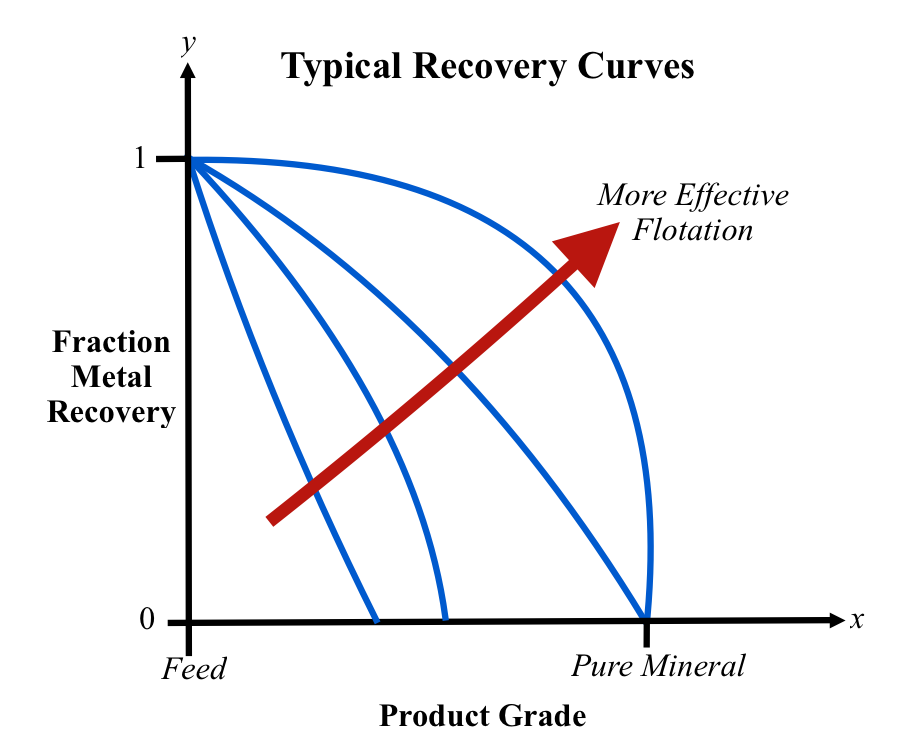
There's also a tradeoff between how much you recover and how pure the final product is. Mineral processors describe this as a "grade recovery curve" [1].
This is definitely purely of historical interest. At best, it's basically saying "medieval Africans' purification process was significantly better than medieval Europeans' process". Either of these methods is handily beat by gold cyanidation and other modern processes.
The right point is pure, while the left point is the grade of your incoming ore. If you don't do anything to the ore, you can recover all of it at the grade it's at currently. If you only take the very purest parts of your ore, you get very little recovery.
Yes, I'm a little curious too. Presumably Africans had lead available (right?) so does the choice of glass imply that it was superior to lead? Or, since Europeans also had glass, is it vice-versa (maybe lead requires better furnaces to be workable or some other technical requirement)?
I feel like the goal of this procedure might be to do everything “locally” to a river gold-panning site. It doesn’t really matter if you have a lead mine somewhere, if it costs a ton to transport the lead to where you’re panning for gold, especially if you’re only going to be getting tiny amounts of gold out of whatever process you use. You probably want a process in such cases that extracts gold with as cheap/abundant materials as possible, materials you don’t have to transport but which can instead be created from the river itself.
Mills have historically been on rivers for precisely this reason. They can move logs to the mill by floating them down the river; they can put processed wood on a boat and float it further down; and they can put a waterwheel in the river and directly use the mechanical power of the wheel (using a mechanical transmission much like the one in older cars) to power the belts feeding the mill. All of these choices are intended to decrease transport/labor costs in a world where those costs dominate other considerations.
And the last one, I think—mechanical power transmission from the river—is also a clear example of another idea: millwrights have a lot of institutional knowledge about “doing things with the mechanical power of a river”, but they might not know anything about electricity. So the “obvious” way to automate the mill, to a millwright, is by using the mechanical power of the river, rather than by sticking a generator on a waterwheel and then powering the mill electrically.
I would guess that in a similar sense, jewellers (who glass-making was originally associated with) know more about working with glass, and pretty much nothing about working with the sort of chemicals and materials you get from mined ore; so if you tell a jeweller to purify gold, they’ll try to use what they have laying around—other jewelry-making materials and processes—to invent a way to purify gold, rather than concluding that the correct method is to go mine some stuff far away and bring it back here.
——
Or, for a more cynical take on what I just said:
If you take “1800s millwright”, “1800s electrician”, “early-BCE jeweller”, and “early-BCE chemical ore refiner” all as artisan guilds that were preciously hoarding their secrets of how they did the things they did, then the millwright wouldn’t have access to knowledge about electrical generators, just like the electrician wouldn’t have access to knowledge about mechanical transmissions; and the jeweller wouldn’t have access to lead-based gold extraction methods, any more than the ore refiner wouldn’t have access to glass-based gold extraction methods.
But if Guild A discovered that Guild B had somehow found knowledge of (or independently discovered) one of its own “trade-secret” processes, and was now doing that process as a step in their own work, the guild that “owns” that process would [threateningly] insist that they should be doing that part of the work themselves [increasing labor costs on the final product by a huge amount]—with the alternative option being simply grabbing all their guild-members and kicking over the other guys’ operation.
So each guild would be highly incentivized to invent solutions to its problems that only relied on its own guild’s knowledge, rather than bringing any other guilds into the process. The millwright wouldn’t want electricians up in his business; the jeweller wouldn’t want chemical ore refiners involved in his gold-making. So they’d each invent solutions that, while perhaps suboptimal, are entirely just “a millwright solution” or “a jeweller solution” to the problems.
(Mind you, I’m not saying that there were actual professional guilds in either case; but rather, that this sort of us-vs-them mentality among the trades is very common historically, whether formalized or not—especially when you have trades that follow racial/cultural lines (banking, fortune-telling); or were associated with a particular religious sect (beer-making, ink-making); or, of course, were themselves the sort of unique fighting skills such groups developed to protect their group, e.g. pretty much all martial arts developed throughout history. People would “rip off” any of these techniques at their own peril.)
"...According to Walton, Europeans in the 10th and 11th centuries purified their gold through cupellation, a process in which lead is mixed with gold laced with impurities, and then heated in a furnace until the droplets of purer gold can be skimmed off. But in the case of medieval West Africans, “They were taking the ore and other raw materials from the river and mixing it with glass,” says Walton. Since gold is inert, it doesn’t fully dissolve into melted glass, while impurities and other materials do, making this “a really novel way of using recycled glass material.”....."
Because many of the currently known national boundaries didn't exist back then, and the tribal delineations would be wholly unfamiliar to their audience.
In this specific case, however we’re talking about Mali which is a modern nation. The borders aren’t the same but that’s true of many nations which still get mentioned by name.


Or is it strictly of historical interest?
Can this decrease mercury pollution of the environment, especially by the poorer small scale gold refinement? Or has that already been succesfully replaced world wide?
Edit: I have no clue why this got downvoted? I don't mind being downvoted, but please don't squander an opportunity for interesting discussion?