That relies on the fundamental assumption that all criminals will reform their way after a few years in jail and therefore deserve a second chance. Most criminals should but I don't think everyone agree that all criminals should. The alternative to the death penalty for the most dangerous criminals is to be able to lock them up forever or until such age that they cannot cause any more harm.
In that respect I see these short sentences for very serious crimes (multiple murders, etc) to be more dangerous than helpful.
Obviously it's only a problem in countries where you have significant levels of violent crimes.
Even in countries that have maximum prison sentence length, people who are considered dangerous are still not let out into the public. They'll stay until they are considered rehabilitated. For dangerous people that have mental health problems, they don't get a prison sentence at all, but they will be forced to stay in a treatment facility until they are no longer dangerous to others.
At least that's how it works in Finland. The whole system is designed to get people to become productive and healthy citizens with minimal suffering, not to provide retribution.
However, what's wrong with retribution? If my daughter was raped and murdered, how should that person be 'rehabilitated?' My daughter would still be dead and the criminal would be able to resume his life. That isn't fair by any definition.
What happens to a victim of any crime is never fair and you will never restore that fairness with any punishment.
You can accept that, adjust your goals and move forward or deal with the inevitable frustration and anger of being unable to get vengeance for the rest of your life.
On one version of retributive thinking, retribution isn't really about restoring fairness, about balancing out cosmic scales of justice. It's about giving a person what's due to him or her. We call it reward when what's due to her is a result of good she's done, and we call it (retributive) punishment when it's as a result of evil she's done.
On that view, it's generally just right to reward people for good and punish them for evil. Consequences -- even grand ones like balancing the cosmic scales of justice -- don't enter it.
But the primary purpose of justice is to punish criminal behaviors. We may want as a secondary goal to reduce recidivism but it cannot be at the expense of the primary goal. I strongly disagree with the idea that criminality is a form of mental disease and that prisons are just a sort of hospital to cure criminals.
For the same reason the severity of the sentence should be driven by the aversion of the society to the crime committed more than considerations on what will happen to the criminal after the sentence has been executed.
The purpose is neither to punish, nor to rehabilitate: A perfect criminal justice system is one that prevents future crime, while at the same time minimizing how many people aren't doing something useful with their lives. Imprison or kill someone that could be helping society, and you are failing too.
Punishment and rehabilitation are just parts of achieving the goal: Punishment tries to prevent further crime, both by the person being punished, and people that know what will happen to them if they are caught. Rehabilitation is great when it succeeds: Sending a rapist out to do more raping isn't so great.
All of our policies about punishment, rehabilitation and enforcement quality are tradeoffs, and the question is what's the best tradeoffs. The biggest one, IMO, has little to do with the size of the punishment (they are all pretty big), but with deterrence. Nobody is going to stop killing someone because they'll "only" get 15 years in jail. 15 years in jail is horrible for most people that aren't living in terrible conditions outside. The real kick is in chances of getting caught. The criminal believes that he won't get caught, so the size of the punishment is not necessarily that relevant, other than in keeping the person that committed the crime away from doing the same again outside of jail (crime vs other immates happens!). Improved enforcement quality, and making sure that people just don't even want to do criminal things, regardless of the punishment, is where it's at.
The problem with that is that enforcement itself is a tradeoff: We could do a lot to prevent crime in NYC if 25% of people were in some form of law enforcement (including policing the police), but it'd be a tradeoff we'd all be unwilling to make, because it'd be very wasteful.
Why punish people? That's not a goal, not a moral value or something anyone should have a desire to do.
The goal is peace. It has to be peace. You might never reach that goal entirely but you can try and you want people that ensure peace exists and people that restore it once it has been violated.
Quite clearly exerting vengeance through the justice system is not the best way to achieve that goal, in fact it's obviously by far the worst.
The only form of primitive justice is the law of talion. The problem with the law of talion is that it relies on the capacity of the offended party to retaliate on the offending party. If the offending party is too powerful, there is no justice.
That's why from feudal to modern societies, the Lord / King / Judge renders justice. The system becomes just again by the retaliation being decided and executed by a higher form of authority.
If someone beats me up, and we both go in front of the judge and the judge decides to do nothing because of some procedural reason or because doing nothing would benefit some greater social good, this is the very definition of injustice.
I am not saying that a justice system shouldn't care about rehabilitating criminals after they serve their sentence, but that negating the punitive role is negating the very reason why the justice system exists and is accepted.
I'd argue that the purpose of justice is to ensure that a society can be sustainable in the long term.
That means justice is combination of deterrence and rehabilitation to a. discourage behaviours that are detrimental to society as a whole and b. to ensure that the offender ceases that behaviour and becomes a productive member of society again.
'Punishment' can play as small or as large a part in point (a) as you want, but the more you make it a large part of (a), the less success you will have with point (b). And failing at point (b) means you effectively fail point (a) - ie offenders coming out of the justice system who can't integrate back into society often reoffend.
Retribution serves you, it does not serve the community.
There is also a quote of Gandhi I cannot find. So I'll paraphrase: If you are angry at someone, and he did not intend to hurt you, you should not be angry. If he did intend to hurt you, he is not as wise/it's in his nature, and you should not be angry.
Let's take an example, which is actually not that theoretical (this happened several times in Europe). Say a Saudi prince, in one of his depraved cocaine trips to London, rapes a British girl. He is arrested, presented to the court. If he is sentenced to jail, the Kingdom of Saudi Arabia will react very badly and blacklist the UK from all future contracts, resulting in hundreds of people losing their job in the UK, and hardship for their families. The British govt asks the court to be lenient and to let the prince go. The court obliges. Is this justice?
If we follow your logic it is. Retribution would only serve the British girl but not the community. The community has nothing to gain from punishing the prince but everything to loose from loosing all these Saudi contracts. If you think justice is only about serving the community, not about retribution then you will happily approve the decision of the court. My personal position is that it is the very negation of justice, and that behaving this way jeopardize the acceptance of the judicial system by the population.
As for Gandhi, it's similar to the Christian "if someone slaps you on one cheek, turn to them the other also". But I am not sure that a recipe that worked well against a democratic British parliament will work as well when facing a violent thug.
> There is also a quote of Gandhi I cannot find. So I'll paraphrase: If you are angry at someone, and he did not intend to hurt you, you should not be angry. If he did intend to hurt you, he is not as wise/it's in his nature, and you should not be angry.
What? Why shouldn't I be angry if a fool intentionally hurts me?
That isn't fair by any biblical definition, but luckily not everybody cares about that.
The way people are treated shouldn't be based on what the most emotionally invested people want. What makes the person rehabilitated is that they don't do the crime again, and nothing else. You can't cause wrongdoing to someone who is dead, so the only downside to releasing the person is you might feel sad. Only if you dwell on it for the rest of your life. But you won't, people move on.
Wait. So, on your view, it's fair -- "Treating people equally without favouritism or discrimination" or "Just or appropriate in the circumstances", according to oxforddictionaries.com's top two definitions -- for a rapist-murderer to be able to get on with his life (maybe after 20 extremely frustrating but possibly also fruitful years for him) while an innocent young lady's is tragically cut short?
And you think it's an indictment on Biblical (and, apparently, also Oxonion) definitions of "fair" that they'd disagree with you on that?
Neither of those definitions disagree with me. I mean, if you read it with your apparently biblical bent, then "treating people equally" probably means the rapist should be raped and killed. But no sane society thinks that's a good idea.
"Just or appropriate" doesn't actually say anything about what should be done in a case of rape+murder. Who's to say life in prison is appropriate? I don't think it is. It's a waste. The young lady wasn't put in a hellish environment for a lifetime. And what do we as a society gain by wasting money on prisoners for exactly zero return on investment? We're basically punishing ourselves to spend that money. Better to wait until the problem is solved (i.e. we don't think they'll do it again) and let them out where they can do something useful.
We could make all sorts of assumptions and appeals to common sense, but we would be wasting our time because we have statistics.
The US has the highest incarceration rate in the world, the largest prison population in the world and a much higher violent crime rate than the vast majority of western countries. Objectively, the justice system in the US is inferior to the European system. This is not a matter of opinion or ideology, there is strong empirical evidence.
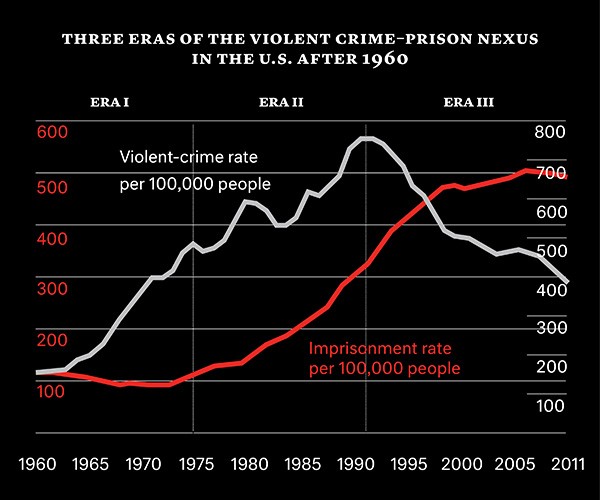
The U.S. had much more violent crime long before its current incarceration policies. At the start of the 20th century, the homicide rate was several times higher than in the UK. Meanwhile, the rise in incarceration in the last several decades lagged the rise in crime over that period by about a decade. It wasn't until 1998 that incarceration caught up to the increase in violent crime since the 1960's, though it has overshot since then.
The problem with these types of comparison is that you are comparing very different populations with very different cultures.
If you could compare populations like that, then for instance the idea of banning guns to reduce the number of shootings in the US would be defeated by the example of Switzerland where pretty much every man has an assault riffle at home, and where you see little to no crime, and certainly no mass shooting. But the reality is that Swiss citizens behave differently than US citizens.
> The problem with these types of comparison is that you are comparing very different populations with very different cultures.
The comparison shows that it is possible to have low violent crime rates and low incarceration rates. After seeing that this is possible, I cannot understand why a country like the US would not go after these two goals. I am inclined to suspect that it has something to do with turning the prison system into a private business and the predominance of puritanism in American culture.
And let's not exaggerate the cultural differences between the US and Europe. We are talking about western democracies, stemming from the same intellectual source (the Enlightenment) and the same genetic source: the US was created by Europeans, and mostly consists to this day of people of European descent (yes, including "hispanics", as the name implies).
> the idea of banning guns to reduce the number of shootings in the US would be defeated by the example of Switzerland
The idea that banning guns is a requirement to have a peaceful society is effectively defeated by the Swiss example. It show that private gun ownership cannot be the ultimate cause of the problem.
By the way, the graph that is shown somewhere else, comparing incarceration and violent crime rates, shows no correlation between the two. A concept of "eras" has to be introduced to allow one to talk about these two metrics together.
> the US was created by Europeans, and mostly consists to this day of people of European descent
Yes, but the statistics for violent crime in the US break down in interesting ways once you start looking at "genetic source", whatever that is. There is lots of discussion as to the _why_, of course
"Hispanics" in the US includes people of nearly pure European descent, nearly pure Amerindian descent, mixes of the two, etc. It's a pretty useless demographic category, really.
> That relies on the fundamental assumption that all criminals will reform their way after a few years in jail and therefore deserve a second chance.
First of all, most countries with a life sentence does not have an upper bound (would be silly to call it life inprisonment), but rather a practice with an average sentence of such a length. There is nothing that prevents someone who is consideered dangerous to be kept in prison longer.
Second: Those who are kept the longest behind bars are those who are sentenced to psychiatric treatment (It's actually odd that you can be sentenced to psychicatric treatment, but you can in many european countries). That is essentially "you'll get out when you are no longer dangerous to yourself or others", which in many cases can be much longer than even the longest prison sentences. Many mass murderes and similar will be in this category.
Third: the idea behind short sentences is diminishing returns, the responsibility of the system to reform the convicted (if they fail it's their fault) and perhaps most of all - econonomic reasons. Unless I see concrete evidence that longer sentences are actually cost effective for keeping me safer, I'm not going to allow politicians to make such laws.
Cost effectiveness is key. One can't just argue that longer sentences automatically makes the streets safer, since it costs a lot. You have got to compare, dollar for dollar, with the effect spending the same money on (for example) Police, Drug treatment, Education, Job creation, ...
So the fundamental assumption is not that all criminals will reform, but that most will, others will at least reform enough to not be dangerous enough that the cost of keeping them in prison is worth it to society - the money can be better spent elsewhere.
In Northern European countries rehabilitation of prisoners to enable reintegration back into society is viewed as the primary goal of incarceration. So if they're unable to rehabilitate someone after 16 years that's viewed to an extent as a failure of the system. The number of people who can't be rehabilitated after 16 years of such a system is likely to be tiny.
Also worth noting that most long term prisoners will not serve their whole sentence in a normal prison with bars and such. They will be moved to a quasi open prison where they get limited freedom to roam, work, structure their day and so forth. At least in Norway. Most people, criminals or not, are not clinically insane axe murderers.


In that respect I see these short sentences for very serious crimes (multiple murders, etc) to be more dangerous than helpful.
Obviously it's only a problem in countries where you have significant levels of violent crimes.