Political parties are a bad idea. George Washington himself went to great pains to explain why in his farewell address.
The gist of it is, political parties divide us, and the goals and motives of the party start to take precedence over the goals and motives of the people the party is supposed to represent. To bring this home, if you think the choice between two political candidates amounts to a choice between the lesser of two evils, then the parties have failed us completely and ought to be ousted. Both of them.
A couple of excerpts concerning the warning against political parties:
>One of the expedients of party to acquire influence within particular districts is to misrepresent the opinions and aims of other districts. You cannot shield yourselves too much against the jealousies and heartburnings which spring from these misrepresentations; they tend to render alien to each other those who ought to be bound together by fraternal affection.
Political parties are deceptive and divisive...
>They serve to organize faction, to give it an artificial and extraordinary force; to put, in the place of the delegated will of the nation the will of a party, often a small but artful and enterprising minority of the community; and, according to the alternate triumphs of different parties, to make the public administration the mirror of the ill-concerted and incongruous projects of faction, rather than the organ of consistent and wholesome plans digested by common counsels and modified by mutual interests.
Parties can get co-opted by those with the time and means to do so. For example, the 0.01%. The Koch brothers, etc. And government becomes a fight between the parties instead of an operating government. Sound familiar?
>However combinations or associations of the above description may now and then answer popular ends, they are likely, in the course of time and things, to become potent engines, by which cunning, ambitious, and unprincipled men will be enabled to subvert the power of the people and to usurp for themselves the reins of government, destroying afterwards the very engines which have lifted them to unjust dominion.
People who control the parties may become ladder kickers. Removing the things that helped them rise to power, so that they cannot be easily usurped once ensconced. Like the Romney family. Mitt's father was a beneficiary of the social programs Romney claims to want to terminate. The very definition of a ladder kicker.
>The alternate domination of one faction over another, sharpened by the spirit of revenge, natural to party dissension, which in different ages and countries has perpetrated the most horrid enormities, is itself a frightful despotism. But this leads at length to a more formal and permanent despotism.
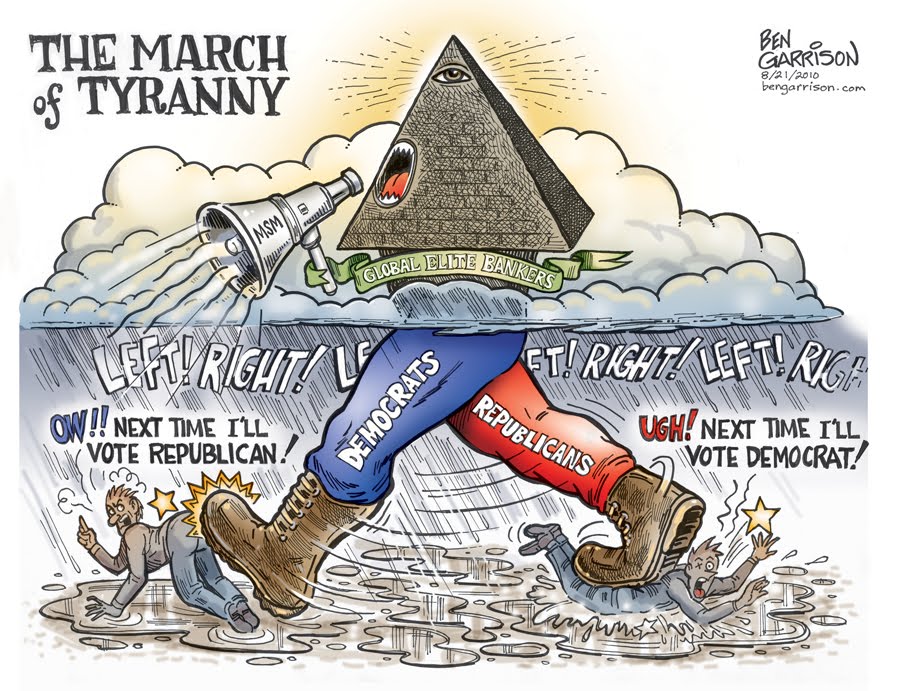
Democrat vs. Republican.
>The disorders and miseries which result gradually incline the minds of men to seek security and repose in the absolute power of an individual; and sooner or later the chief of some prevailing faction, more able or more fortunate than his competitors, turns this disposition to the purposes of his own elevation, on the ruins of public liberty.
>Without looking forward to an extremity of this kind (which nevertheless ought not to be entirely out of sight), the common and continual mischiefs of the spirit of party are sufficient to make it the interest and duty of a wise people to discourage and restrain it.
Keep an eye on political parties.
>It serves always to distract the public councils and enfeeble the public administration. It agitates the community with ill-founded jealousies and false alarms, kindles the animosity of one part against another, foments occasionally riot and insurrection. It opens the door to foreign influence and corruption, which finds a facilitated access to the government itself through the channels of party passions. Thus the policy and the will of one country are subjected to the policy and will of another.
[These are now called wedge issues.](http://en.wikipedia.org/wiki/Wedge_issue#Wedge_politics_in_t...) Ostensibly issues everyone cares about, but really a tool to separate us into chunks and have us at each others' throats while those actually in power do as they please while we are fighting amongst each other over issues that ought not be the government's business.
It's not just about calories but overall nutritional value. The orange juice contains significantly more vitamins than the soda -- hell, the site you linked rates orange juice as healthier than soda, which should be telling.
Which kind of slavery? Wage slavery is alive and well. It is the slavery of the 21st century, and continues today. Or can you quit your job without going bankrupt due to debt unlike me and millions of others like me?
Debt for an individual is a choice. However our monetary system mandates that some people or entities must always be in debt. If there were no debt there would be almost no money in circulation.
So while you say that debt is a choice, it is impossible for everyone to be debt-free. If everyone stopped borrowing (consumers, industry and government) in this country, we would have a complete economic breakdown.
This is like saying smoking is a choice: from the perspective of the single potential smoker, it is. From the perspective of the marketer this is unimportant as they don't need you to smoke, they just need some people to smoke.
I think this was it. They also allowed you to change the key of the piece before you printed so this is where a digital score is shown to be far superior to a piece of paper but if you want it in every key then they want you to pay them twelve times. No thanks.
(If you're running Windows) Microsoft's XPS Document Writer is pretty good for this. It results in a .xps file but you can do whatever you want with that afterwards, including PDF conversion.
Unfortunately, many pieces are longer so they fit on more than one page. Of course, one motivated enough could still print screen each page. Even easier on a Mac where you can select a rectangle to print screen from with Cmd+Shift+4.
Some software has been developed to prevent print screening. I've also seen the web variant of this, to prevent you from doing right click - Open image in new tab. Used on some of those funny images sharing sites.
That is because, right at its heart, the _universe_ does not respect owning information. Therefore it makes no sense that some subcomponent of the universe, say a person, or other entity could either. Sure, you can own a book on which information is printed, or multiple "copies"; that is, multiple physical books. But to the universe they are not copies, they are discrete physical entities. But when you are only splitting energy streams, that is making electronic copies; those are true copies. And this is where the lie that is "copyright" steps in. Literally, "the right to copy". As in, some entities, typically people, have it, and some do not. The fact that a new term had to be made up to give this fictitious idea a reality illuminates how baseless it is in the actual universe outside human society. Since the entire thing is predicated on a lie - the lie that the act of copying electronically can truly be controlled - it is intrinsic that it cannot last, since it has no basis in reality outside our minds. The would-be copyright owners sort of admit this when they try and use scare tactics to keep people from infringing on their so-called copyright. They do this with big FBI warnings (which the FBI had no hand whatsoever in creating), and those stupid "you wouldn't steal a car, would you?" ads. It sounds almost like someone is trying to convince _themselves_ of the veracity of owning information and the right to copy it. I, for one, think that the sooner the human race gets the hell over the idea that information can be owned, the better. There are other, better ways to make money through entertainment, and the entertainment industry is sooner or later going to have no choice but to face the music. It has been happening for decades, and the ubiquity of computers is making it worse for them, and better for everyone else, at last.
The universe also doesn't respect owning property. Saying that an arbitrary collection of atoms (a chair) belongs to another arbitrary collection of atoms (a human) is delusion pure and simple. It's just a delusion that a lot of arbitrary collections of atoms (humans) share.
Which, of course, is the whole point: property is an illusion with utility. For physical things like chairs, the concept 'makes sense.' What OP meant by invoking the universe was really to say that _people_ don't respect intellectual property.
And if you look closely, people don't respect physical property to an exact degree. We share, we borrow, we lend, we lease, we sometimes treat human work as property, we're generally just lazy with our accounting of ownership. Which, you know, is kinda cool.
Anyway, you use the word arbitrary as if the arbitrary nature of the line makes the line meaningless.
The way in which owning a physical thing "makes sense" is that you can defend a physical thing. You can move it to a location that's easier to defend, or build defenses around it, or whatever. Physical property is about defensibility; it's not a metaphor, but a capability. Information-as-property is a metaphor, precisely because defending the part you "own" of (what is otherwise) someone else's computer is so difficult as to be effectively impossible.
I think what Produce means to say is that many of our institutions and cultural facets are made up. There is very little natural backing for many of the laws and customs of human society (human rights? ha.) Invoking natural law to make a point about the utility of an abstraction makes no sense in context of all of the other abstractions that we use frequently in our lives (eg, property).
Actually, I was making the opposite side of the same point. Personally, I consider the existing abstractions to be as irrational as these new ones. It seems, to me, that people are hugely over-complicating life while arguing that survival is not possible any other way (or that the current way is the best we've got). The simple fact is that we fall prey to fear very often and construct these elaborate schemes to make us feel more secure. It would be more efficient to, as a species, at least make an attempt to face our fears. The issue is that we're biologically wired to survive in an environment of scarcity. We go kind of crazy (in the sense that our ideas do not match reality) when things are abundant.
But again, that's precisely the whole point. The natural law is whatever we decide it to be. Whereas you say 'made up' with its connotations of fantasy, the 'unreal' nature of our abstractions does not distract from the fact that they're very real in practice.
In other words, there is nothing to invoke but natural law; and there is nothing behind natural law. Invoking natural law is _itself_ the means by which natural law gains utility.
What laws do you think are real? The only 'real' law is the Sparrow Predicate: what a man can't do, and what a man can do. _Everything else is built upon this._
That is to say, it is distracting and adding nothing sensible to point out that physical property, too, is an abstraction--it is merely an extension of the original point, which is: people don't buy into the intellectual property concept nearly as much as the physical property concept.
I agree. That's exactly why they can't and will never be able to stop piracy on the Internet. Copying and sharing information on the Internet is designed into the Internet, and it's a fundamental principle of the Internet. Trying to stop it through outside "artificial" laws will not work. They manage to stop one thing and 10 better alternatives appear.
None of his arguments are invalid save the "early adopter wins" scenario.
On every other count he either misunderstands current banking systems, bitcoin, presents a pseudo-argument, or some combination of all three. Honestly, except for the early adopter winning part, the whole thing reads like a shill post designed to do nothing but defame bitcoin. He even calls it a scam. By that measure The Fed is the biggest scam that ever invented if you look at who receives the "printed money" first. They are the "early adopters" in his "bitcoin is a scam" analogy. And they are still in power. So does that really make it any worse?
Here's a different perspective for you guys that is more or less in agreement with Chomsky's:
The universe does not recognize our artificial restrictions on information.
This is inherently why people generally think it's ok to violate the copyrights of others. Because we know, and the universe knows that nothing was taken away from them. The restrictions are entirely artifical and designed to do nothing except create an enormous inequality between the the "owner" of the information, and everyone else. That's the sole purpose. These Imaginary Stuff owners then use this disparity (a legal fiction entirely) to generate massive wealth based on entirely contrived circumstances.
Since the dawn of speech nothing like this has existed because it never made sense. Anything one person said could be repeated by anyone who could remembered it. So when did information suddenly become ownable? It's a nonsensical legal fiction of epic proportions.
I contend that if the information is publicly available, you no longer own it. This is how the universe operates. Fans of Imaginary Stuff rights will not be able to get their way for long. Or rather, they shouldn't be allowed to use the legal system to enforce their artificial disparity. If you want to own information, keep it a secret. Otherwise, it's everyone's.
Another way of looking at it is, if you want to get paid for good information/content/art production, you're going to have to do what every other human does, continue working even after producing great works. You should be valued for your talent, and ability to produce from it over and over - just like everyone else. A bricklayer doesn't lay one brick really well and then charge everyone to use it daily. The value should be placed on the ability, not the product, since there's no physical product at all really. The slight exception being physical works of art etc, but then they're not just information, so the rules I'm talking about do not entirely apply. Photographic reproductions are information, but an original work in physical form is still valuable for being the first and physical.
What do you other smart folks think about this? I know a lot of us work in information production in some form. I myself am a software engineer, so I'm not just trying to take from everyone else and pretend the rule doesn't apply to me because I'm not an information/content producer. I actually am. So this hits me hardest too.


Free will is great way to avoid stagnation if we were to but use it.