I've been very impressed with Phind.com; at this point it has basically replaced 80% of my web searches for technical questions. The linked sources help with verification and getting context when necessary.
Unnecessary pressure and unrealistic growth expectations push toward quick and sure enshittification of a successful service or the shutdown of an insufficiency (unrealistic) successful one.
My hat said I love phind very much - hope you can stay in business.
We have great investors (including YC) who are very much aligned with our goal of making the most kickass pair programming assistant that's plugged into everything (including the internet).
ncdu is one of the most useful CLI tools out there! Been using it for many years as well.
Another disk scanner worth plugging that I came across for some use cases where I needed to generate single-view reports is pdu - it has the same concurrency implementation that other ncdu alternatives use so the performance is much better too.
Agreed - if the situation is as dire as presented then nuclear fission is the only clear solution today for baseload power. All the rebuttals I usually read seem to present hypothetical alternatives that may very well come to fruition but we have nuclear as a well-tested and known solution to the problem ready for us to begin using today should we simply decide to act.
I don’t see a path forward without Nuclear. Europe and China has done better in this area than US. There is a bunch of fear mongering in liberal California circles about Nuclear. Well informed and technically minded people I know in Bay Area all support Nuclear power.
Frankly the media has done an awful job of fear mongering with the term “Nuclear” and “Radiation”.
New York just decommissioned the Indian point nuclear plant [1] due to some shady politics. The largest planned solar installation in the US was defeated by environmental groups because it would be an eyesore [2].
At some point we’re going to have to grapple with the fact many “concerned” groups don’t actually care about climate change. Instead they use it as a stalking horse for other political projects.
The group that stopped the solar installation was something called "Save Our Mesa":
> But a group of residents organized as “Save Our Mesa” argued such a large installation would be an eyesore and could curtail the area’s popular recreational activities — biking, ATVs and skydiving — and deter tourists from visiting sculptor Michael Heizer’s land installation, “Double Negative.”
The group itself is not in any way an environmental group, they claim to be locals who want to save their tourism industry.
> The majority of our community’s revenue comes from tourism. We lost a lot of tourism and businesses when the shrinking lake levels of Lake Mead occurred closing a nearby beach. We have struggled but built back our economy through OHV tourism. When people come and camp/hotel for a week, they buy our gas, our groceries, eat in our restaurants, use our mechanics and parts stores. This allows these businesses to thrive thus keeping us self sufficient. Feedback from many of our Snowbirds was that they would look for new places to go, that’s lost revenue. People would not come to recreate, that’s lost revenue.
I did read the article. Specifically, I read the second to last paragraph which states,
> Although a majority of the state’s voters approved an energy transition ballot question last year, large-scale projects like Battle Born Solar have drawn backlash from conservationists, endangered species advocates and local businesses that cater to tourists.
But you don't need to take anyone's word for it. Here is a local group very proud to assist Save our Mesa to kill the project [5][6][7].
If you would like to read more about how environmental and conservation groups sometimes oppose renewable energy projects, you can do so [1][2][3][4].
1) Save Our Mesa is the group that pushed back, successfully, against this project, to further the tourism interests in their town, according to the article and according to them.
2) Some infrastructure projects "like this" (i.e. not necessarily this one, but simply projects "like this") draw backlash from environmental groups for whatever local reason. (also, this does not mean Save Our Mesa, the group responsible for stopping this project, is an environmental group.)
3) A local group (Basin and Ranch) was happy that "grass roots killed this project" and they were "happy to help" (in an undisclosed way) -- this also does not mean that "environmental groups" stopped the solar installation "because it would be an eyesore," which is what you said in your original post.
Look, I get that environmental groups sometimes behave in ways that seem irrational, too focused on some small local issue (Basin and Ranch likes the tortoise habitat more than they like solar), but this kind of sliding different issues, takes, positions, etc., together is dishonest and shitty, whether intentional or not.
It's a whole bunch of dissimilar designs - maintaining all that must have been nightmare.
In comparison here in Czech Republic & in Slovakia we have a bunch of upgraded VVERs and that's it, providing a good chunk of our electricity with reasonable commonality.
But hey, it could be worse than in Germany! You can build a complete nuclear power plant with all the expense it entails and then newer run it! ;-)
I really wonder what all the China talking point sorts will do the day China not only beats us on emissions per capita but also on total emissions? What excuse to continue doing nothing will they pivot to then? India?
When I saw the Greenland study on HN[1] last night, all I could think is how much more worse does it have to get before we refocus on building fission plants and doubling-down on fusion research investment?
Unfortunately the economics of natural gas make it a steep hill to climb even if the politics and public sentiment changed on nuclear. To me, fission really seems like the only rational solution to the climate crisis that we can implement starting tomorrow.
We probably do need either carbon taxes or heavy fission plant construction subsidies (easier to implement than carbon tax and most of the negative economic incentive is the capital-intensive upfront costs - nuclear is significantly cheaper than gas at the 35-40 year plant life mark).
I'm a nuclear fission power plant designer. I write a lot about nuclear reactor development history and nuclear economics. One of the most interesting ways to decarbonize with nuclear fission at the scale and pace necessary is to use shipyards to serial construct GW-scale nuclear power plants on offshore floating platforms. This allows us to do Henry Ford serialization while capturing economies of scale. This method was very seriously considered in the 1970s and 1000 people built the production facility in Jacksonville, FL. It was called Offshore Power Systems (a joint venture between Westinghouse and the Newport News Shipyards) and there's a wonderful writeup about it in a 1975 New Yorker [1], plus my summary of it from earlier this year [2].
This form of nuclear production got an actual construction license from the NRC after incredible amounts of environmental study.
It may raise eyebrows, but consider that in deep water tsunamis are a few feet tall, earthquakes are non-existent, and huge ships like the Prelude are designed to handle category-5 cyclones. You also have infinite access to cooling water and can design in a sink-safe worst-case scenario with a engineered recovery operation.
If we were serious about decarbonizing right now and I were in charge, I think I would march over to S. Korea and try to get their world-class nuclear construction people (KEPCO) hooked up with their world-class shipyard people and just start hammering them out.
Let's not get stuck into one solution. Need to pursue several. Floating power plants are very promising as there is lots of shipbuilding capability and the worldwide commercial cargo fleet numbers in the tens of thousands of ships. This could scale pretty fast. I do dislike the idea of a power plant surrounded by salt water - it just doesn't help with the chemical/corrosion safety even if you can use as coolant for an extreme accident. Obviously, no earthquakes and less population in the area. But once the accident happens, you don't get to do mitigation like collecting the dust or pieces.
Another strong approach gaining traction is production in the 5-50MW range, with 100s/1000s/yr in the same way Boeing and Airbus build ~2000 wide body aircraft each year. Smaller reactors with lower power density can claim inherent safety with respect to various hazards - ie cannot meltdown through system failures.
Must move away from absolutist mind set with single solution and try lots of strategies. Many will be effective.
I always wondered if the future was something even smaller scale than that.
Something the size of a chest freezer and rated maybe 100kW-- enough to run a few neigbouring homes, or a small office campus. Maybe it's a heat-decay product rather than a steam system, to reduce moving parts and breakdown risk. It's designed as a sealed, maintenance free unit that you dock in someone's shed, it runs for 5 years or whatever, the green "Change Reactor" light comes on, and you call the manufacturer to take it away and drop another one in place. (It could be properly deconstructed and refurbished by the manufacturer, like the old "disposable" cameras). It would probably output something like 240 or 480v natively to integrate in a similar way to rooftop solar.
I figure this can achieve a couple of goals:
* By keeping the scale small, we might be able to get the "worst case" risk profile to something people find palatable (they're okay with some medical facilities with X-ray and radioisotope therapy machines in their neighbourhood, but nobody wants to live next to Palo Verde)
* Transmission losses are minimized and putting much of the generation near demand reduces load on the grid itself if the demand estimates are faulty and we still need to pull peak power from elsewhere.
100 kW may make sense but as part of a large facility with maybe a few hundred of them. Distributing nuclear material so widely would be imprudent. The materials themselves are dangerous, there's no getting around that and there's real value in a minimum of centralization and control of the reactors in one place. A turbine generating half a gigawatt is also much more efficient (orders of magnitude) than 5000 turbines generating 100kw.
I wouldn't get hung up on transmission and distribution losses--they're something like 6%--and you're missing out on economies of scale with larger installations.
That's what was always so weird about rooftop solar: if solar is so great, why is there more interest in rooftop than large-scale farms? Especially when you look at the installation cost and sub-par location and orientation, rooftop solar is significantly worse than a farm. Transmission from a farm will be less than inefficiencies because of roof angle.
TBH, I'm astounded. I always went off a discussion we had in a 100-level physics class that basically boiled down to "We're considering deregulating the electrical market here, but any claims of choosing your electrical supplier is nonsense-- if you wanted to get electricity from one state over, you'd need to buy 6 units to get 1 at the point of consumption." I suspect it may be a combination of figures off by a few orders of magnitude and a worst-case of sending power 500km instead of 50.
OTOH, I am still interested in the grid-fragility aspect-- if the main grid is only carrying relatively low peak power needs, instead of the entire base load, won't we be able to better handle failures? Wouldn't extra redundancy be cheaper and easier to build?
> if you wanted to get electricity from one state over, you'd need to buy 6 units to get 1 at the point of consumption.
There's a chance you were talking about transmission of household voltage. What Ohm's Law does for long-distance energy transmission is amazing
Found this:
> For example, a 100 mi (160 km) span at 765 kV carrying 1000 MW of power can have losses of 1.1% to 0.5%.
And also
> As of 1980, the longest cost-effective distance for direct-current transmission was determined to be 7,000 kilometres (4,300 miles). For alternating current it was 4,000 kilometres (2,500 miles)
Yes SMRs look very promising and I believe NuScale has one commercial plant in the early stages of production but it won't even be finished until the end of the decade[1].
The optimal mix using today's technology seems like it would be traditional fission for baseload combined with (solar/wind + battery) / hydro for variable / peak grid load.
SMRs likely will suffer from diseconomies of scale. If economies of mass production make up for that, it will be awesome if not surprising.
That's why I like combining economies of scale with economies of mass production with large reactors built in shipyards. Decarbonizing requires many new TW of capacity. Exajoules is the unit of import.
Russian Akademik Lomonosov [0] is already a working example of such technology (well, apart from it being "only" 0.3 GW). While I think this direction has certainly has its niche (somewhat similar to floating storage and regasification units), I don't think we should view it as a general replacement for ground-based plants. It's not only about economics (after all floating plant inevitably will cost more), but providing energy to users deep inside land mass.
- no one has yet solved the waste problem (okay, the US has ample free land, but the rest of the world does not!)
- the proliferation risk is not eliminated (and no, it's not only plutonium, but also ordinary uranium for dirty bombs to take care of, plus the risk of enrichment tech, as evidenced with Iran)
- uranium fuel is mined under incredibly exploitative conditions. Additionally the US doesn't have meaningful uranium reserves on their territory, dito for Europe. Does the world really want a repeat of the oil crises, with some random sheikhdom having the world by the proverbial balls?
- safety issues haven't been solved at all: terrorism (hijacked airplanes) remains a constant threat, operator error/sabotage is a risk, and capitalism leading to corner cutting in construction, operation and demolition is popping up every other year.
Fission is a dead end, the hope is solar, wind and battery storage.
> no one has yet solved the waste problem (okay, the US has ample free land, but the rest of the world does not!)
Waste is completely overblown as a problem. Solar and windmills have much lower energy density than fission. So your zero-carbon alternatives to storing fission waste somewhere are:
- Find even more land from somewhere for solar/wind farms, or
- Vastly reduce electricity consumption
Neither option really seems better than storing fission waste.
Given that two of the three countries with the highest known uranium reserves are Australia and Canada I'm not too worried about "random sheikhdom having the world by the proverbial balls"
Mostly right but for the wrong reasons. Fission is on the way out as a widespread commercial scale power source buts that’s got everything to do with politics and economic up front costs and uncertainty of future electricity prices. The waste problem is only intractable because the politics are intractable, the technology part is not an issue. Political incentives simply are not set up to make it realistic for politicians to tackle the waste. Unless suddenly society becomes entirely populated by ultra rationalist super well educated people, there is no changing this current state.
Soon it will be possible to use most of the waste as fuel:
"...Fast reactors can "burn" long lasting nuclear transuranic waste (TRU) waste components (actinides: reactor-grade plutonium and minor actinides), turning liabilities into assets. Another major waste component, fission products (FP), would stabilize at a lower level of radioactivity than the original natural uranium ore it was attained from in two to four centuries, rather than tens of thousands of years"
While there are issues with nuclear power, the worry people have about nuclear waste is greatly overblown to say the least. The amounts generated are manageable and in a relatively short amount of time we can use most of this "waste" to generate electricity.
>...- the proliferation risk is not eliminated (and no, it's not only plutonium, but also ordinary uranium for dirty bombs to take care of, plus the risk of enrichment tech, as evidenced with Iran)
This isn't really relevant for commercial nuclear power - no country has ever gotten a nuclear bomb from commercial nuclear reactors. No terrorist has ever gotten access to nuclear waste. There are lots easier ways for terrorists and countries to obtain nuclear material. (Nuclear designs like the Integral Fast Reactor keep everything on site (including reprocessing) so the terrorist threat would be even more unlikely.)
>..- uranium fuel is mined under incredibly exploitative conditions.
Better than mining rare earths or coal etc.
>...Additionally the US doesn't have meaningful uranium reserves on their territory,
With next gen breeder reactors, there is enough fuel for tens of thousands of years. (Or thorium reactors might be used, etc)
>...- safety issues haven't been solved at all:
Nuclear power has proven to be the safest form of mass power we have ever created. Yes, like any power source we should worry about terrorism, but that isn't unique to nuclear power.
>...Fission is a dead end, the hope is solar, wind and battery storage.
It is possible there will be some major advances in grid storage that will allow us to stop using natural gas to cover for the intermittent nature of wind and solar. But what if that doesn't pan out? The dangers we are facing in the coming decades are immense. Is your fear of nuclear power so great that if you had to choose, you would prefer the world to suffer through catastrophic climate change rather than use nuclear power?
Agreed, with modern reactor designs nuclear "waste" is a misnomer. The Dutch keep all of their nuclear waste in buildings open to the public for tours, buildings which also happen to house priceless artwork:
> After finding a habitable area and settling there, he named it Grœnland (translated as "Greenland"), supposedly in the hope that the pleasant name would attract settlers.[20][21][22] The Saga of Erik the Red states: "In the summer, Erik left to settle in the country he had found, which he called Greenland, as he said people would be attracted there if it had a favorable name."[23]
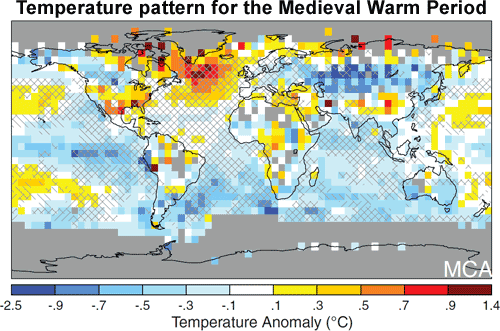
I can't dispute whether or not Erik engaged in marketing, but I wouldn't be surprised if he did. However his voyage was well into the start of the Medieval Warm Period[1], so I'll stand by my claim that there was less glaciation when he named the place.
I'm glad we agree there was a heat anomaly in Greenland when it was named Greenland, which indicates the glaciers had receded.
Digging into that historical data further, what sourcing is there? The wiki page I already links indicates records for most of the world at the time were, well, awful. And that what we do know suggests it was similarly warm and dry in Asia, Africa, and South America.
Skepticalscience.com is a web cartoonist's blog, not a serious scientific source. That said even cartoonists can read and learn, so I'd be very interested in seeing his sources.
While greenland was warmer during the medieval warm period than immediately afterwards, its ice sheet is 400,000 years old. Saying they had "receded" is a stretch, and it is warmer today than it was then. The effect of the medieval warm period was localized to the north atlantic, while the rest of the world was colder, and the north atlantic is already substantially hotter today than it was then.
No, skepticalscience.com is a website created by a web dev cartoonist with absolutely no climatology background[1]. I'm also well aware that Greenland's ice sheet is a remnant of the Quaternary Glaciation[2]. What word would you prefer other than "receded" to say that the extent of the ice sheet was less in the 11th century than it was in the 9th or the 20th?
Also, in the opposite spirit of your opening sentence, let me advise you that "It really seems like you're just trolling" is a very weaselly way to insinuate bad faith, and you should try to do better. If you want to call me a liar or a fool just do it. I don't think you could support that accusation based on my use of sources like wikipedia because I am acting in good faith and a spirit of intellectual curiosity, but hey you do you.
He's an assistant professor of climate communication at George Mason University, and has coauthored several textbooks on climate change. https://communication.gmu.edu/people/jcook20
I'm not able to find any source describing the extent of Greenland's ice sheet during the medieval warm period. If you have one, you should post it. All I can find are temperature records which indicate greenland has been hotter than in the medieval warm period since the 1930s.
I have no idea what "assistant professor of climate communication" is supposed to mean, but it sounds like a journalism credential and not a scientific one. I'd wager it was granted in an honorary capacity on account of his website, not because of any scientific work.
I do find myself thinking though how would my intellectual heroes view that? What would Edsgar Dijkstra think of someone identifying as an "assistant professor of computing communication?" What would Richard Feynman think of someone identifying as an "assistant professor of physics communication?" While I can't be sure, abductive reasoning tells me their view would likely be dim to say the least.
It's my understanding that the name Greenland was used to attract new settlers, not because it actually was a good description.
[From Wikipedia] The Saga of Erik the Red states: "In the summer, Erik left to settle in the country he had found, which he called Greenland, as he said people would be attracted there if it had a favorable name."
Greenland's name was given by Eric the Red, who wanted fellow Norse to settle there. He being there because he got kicked out of Iceland.
Erik (according to popular legend) called the island Greenland and painted the island as being a wonderful place to settle.
It was slightly warmer than even today, but that was a localized warming, not Global. Greenland has had several cold and warm cycles over the past hundred millennia.
I first heard Nardis around a decade ago and ever since it has always been one of my favorite Jazz pieces (if not #1). It was also my introduction to Bill Evans. When researching him I was surprised to learn Nardis was composed by Miles Davis but that there was never a recording from Miles himself.
However, until I read this article I never knew there was such a following around Nardis nor was I aware that Bill Evans had such an obsession with the song. There's something quite satisfying when you discover good music independently and only then slowly discover the existing culture around it.
"The mission concept review board in September concluded the SLS launch option was 'far superior' to other alternatives because it would allow the probe to fly directly to Jupiter in less than two years. Launching on a smaller rocket would require gravity assist flybys of Venus and Earth, adding three-and-a-half years to the voyage."
I think SLS makes a lot of sense for outer planet missions - at least until commercial super heavy lift options are available.
If you look closely in that article, you'll see the price that review board assumed for the SLS was $500 million. That's a number that SLS people like to throw around, but it is far, far less than many outsiders expect it will cost. The SLS is only expected to fly once every couple of years in the mid-2020's, so one or two years of the full cost of the program needs to be booked against each launch. Each will have an effective cost of $2 to 4 billion, and that doesn't even include any fraction of the enormous development cost.
It could easily be worthwhile to spend $500 million to cut a few years off of a $2 billion mission. It's much less likely to pay off when the cost is $2 to 4 billion. That's the equivalent of three to eight extra entire Discovery-class missions, or two to four New Frontier missions.
You make a good point regarding the author's understanding of color blindness, however gray-scale vision absolutely does exist in humans, albeit in a much smaller proportion of the population than common red-green colorblindness:



Great compliment to ncdu for a single-view disk report and blazing fast.