It's not true, in that sense. Commits in jj are basically the same as commits in git as far as mutability is concerned. But in jj you normally work with changes, rather than commits, and open changes are mutable (by altering which immutable commit they point to in the backing store). And there is effectively an append-only audit trail of these alterations (which is what makes `jj undo`/`jj redo` simple).
Some comments here are confusing the issue by saying ‘commit’ when they mean ‘change’ in the jj sense.
Re the grandparent comment, `jj describe` provides a change description, analogous to `git commit --amend --edit` in git terms.
that's actually not what i am after. what i envision is a graphical terminal, that is a terminal that uses graphic elements to display the output.
consider something like grep on multiple files. it should produce a list of lines found. the graphical terminal takes that list and displays it. it can distinguish the different components of that list, the filenames, the lines matched, the actual match, etc. because it can distinguish the elements, it can lay them out nicely. a column for the filenames, colors for the matched parts, counts, etc.
grep would not produce any graphics here, just semantic output that my imagined graphical terminal would be able to interpret and visualize.
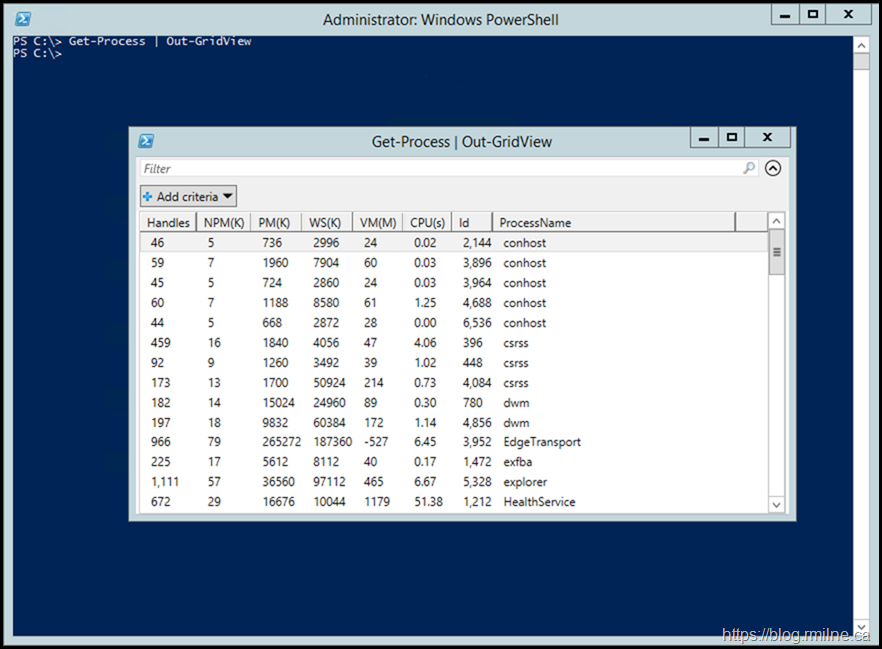
PowerShell cmdlets output .NET objects with properties, in that example Get-Process makes an object-per-running-process with properties for Name, Id, and more. Out-GridView takes arbitrary objects and draws a resizeable GUI window with a list of the input, properties as columns, sortable, filterable, and has options to use it as a basic "choose one of these and click OK" user-prompt. It works with the grep-analogous cmdlet:
and the output is the filename, line number, line, and regex match groups, of each match. [This dates back to Windows XP SP2, in 2004].
If we're talking about things we imagine in terminals, one I have wanted is multiple windows for making notes, similar to having a text editor open constantly reloading a file on any changes and running some terminal commands with tee into the file, but better integrated - so I could keep a few useful context results but ignore logspam results; and "keep" in another window without having to copypaste. Something better integrated - it always gets all command output, but disposes of it automatically after a while, but can be instructed to keep.
That'd be really cool. I'd never thought about enabling deeper graphical capabilities in a shell. But if you were to have a shell with rich objects rather than dumb bytes, that is a world that would open up!
PowerShell, for instance, has Format.ps1xml[0] that allows you to configure how objects get displayed by default (i.e. when that object gets emitted at the end of the pipeline). Such a concept could in principle be extended to have graphical elements. How cool would it be to have grep's output let you collapse matches from the same file!
So are a couple shells that use some kind of webkit tty. VS Code’s integrated terminal counts, I guess.
It could be an interesting paradigm, though, to have a hybrid between fullscreen and traditional tty programs: you output some forms, they are displayed by the terminal inline, but your scrollback just works like normal, and you can freely copy and paste stuff into the form. Once you submit the form, it becomes non-interactive, but stays in your scrollback buffer. You can select and copy textual data from it, but the form’s chrome cannot be selected as line drawing characters.
Probably could be a piece of concept art, I guess.
hmm, actually, you got a point there. emacs could be the like that graphical terminal, except for now it is still stuck inside a traditional terminal itself. even the GUI version of it is mostly just looking like a terminal, not really taking advantage of the potential of graphical elements. we would need a real GUI and support for exchanging structured data with external commands. for now emacs is still kind of its own world.
> even the GUI version of it is mostly just looking like a terminal, not really taking advantage of the potential of graphical elements.
Emacs is text based (mostly), but customization happens through the the concept of Faces, not ansi escape codes. You can then embed properties in the text objects and have them react to click events. The only element missing is a 2D context that could be animated (if it's static, you can use SVG as Emacs can render it).
I think you have somehow picked up an overcomplicated workflow, and this is case is actually something that `jj` is much better at.
If I'm in the middle of working on <foo> and someone asks about <bar>: `jj new <bar>`. When I'm done (and do whatever I want with those new changes in <bar>, including deferring deciding what to do), I just `jj edit <foo>` and I'm back exactly where I left off. It's a bit like `git stash` without having to remember to stash in advance, and using regular commit navigation rather than being bolted on the side.
Couldn't disagree more, I get headaches from blurry text, so I daily drive Terminus TTF, and have done so for years. Modern font rendering really has becole quite terrible unless you own a high DPI screen, even when using full hinting.
And no, subpixel anti-aliasing doesn't help, the colour bleeding is even worse.
Buy a modern monitor or just run your display at a low res and disable antialiasing? Phones are now 500 PPI+, theres no real excuse for using a low DPI screen.
I vehemently disagree. Recently bought a pretty good and affordable 21:9 Chinese monitor, and I couldn't be happier with it. A good monitor is a basic QOL improvement for IT professionals, and these days they're still cheap because they aren't affected by the recent HDD, GPU, or RAM scarcity.
For reference, I live in Mexico, and bought the monitor with less than two week's worth of groceries. Recognized brands would cost four or five times more, but there are options for every budget.
Have you tried to buy tin foil lately? Big Aluminum has taken over, and just see how far you get soldering the grounding strap to an aluminum foil hat.


That's not a transcription, that's an interpretation.
reply