I have a different reason why the conclusion doesn't follow: while it's true that less populous states have outsized influence in the senate, the constitution doesn't require (and in fact, originally discourages) the federal government to engage in the kind of activities being discussed here. These activities should be the domain of the states. But a long history of expanding federal power (and various supreme court decisions affirming those expansions along, in my opinion, dubious interpretations of both the constitution and various statutes, especially the commerce clause) has led to this issue.
The fact that North Dakota has a lot more influence in the US Senate than California on a per capita basis shouldn't be that big of a deal, because the US Senate should be doing a whole heck of a lot less than it is, and states should be picking up that slack.
The more power and responsibility we have given the federal government, the more the issues appear....because it's doing things never intended or envisioned by the founders.
I'm not going to weigh in on quality issues (I have had a 16 for a little over a year and it's been great, but it probably gets far less abuse the way I use it than average), but I'm surprised to hear this because the whole point of Framework is that when something breaks you don't need to "buy another one". You just buy the specific part that broke. Chassis warped? Buy the top/bottom/whatever part of it is warped. Hinges worn out? Replace just those, etc.
The kind of person who is happy to just buy a new one when a particular component breaks seems like the kind of person who would probably prefer to buy something else, or so I would have supposed.
I very much like the modularity, upgradability, and repairability, but those things come with tradeoffs, and if one isn't the kind of person who is interested in repairing a computer piecemeal, I'm not sure I understand why one would accept the tradeoffs.
I like Framework, I like their mission, and I intend to continue to support them as a customer (I'll likely buy the new wireless keyboard as soon as it's in stock), but my intention is to never buy another complete laptop from them again, unless I for some reason decide I need to have 2 laptops. It may be that in a decade or two, I have Ship-of-Theseused my 16 into an entirely new laptop, but I can't imagine the scenario where I replace the entire thing in one go.
The mainboard is what appears to go wrong and it ends up being the same price as many competing laptops.
Maybe this will be different with the pro, but no one knows until they actually ship.
As for the Framework 16, I brought a 5070TI laptop recently for around 1200$ after a nice rebate. After a bit of complaining( which was also needed to honor the rebate ), they added a second year warranty too.
For the Framework 16, with the 5070 addon(which has 8GB of VRAM compared to the 12GB on the 5070TI).
Sure, the framework might be better, but is it worth twice as much ?
I'm really tired of these claims that Mythos is "nothing by PR hype". It should be at this point eminently clear that the people working at Anthropic believe the things they say about their models. And for mythos in particular, at this point there are far too many people outside of Anthropic who have seen it and/or the vulnerabilities it has discovered for "it's nothing but hype" be anything close to a sensible position. I'm not saying we should blindly believe them; they have often used more caution than was entirely warranted (this is, in my opinion, a good thing) but the idea that all of this around Mythos and glasswing is nothing but marketing hype is nonsense. Might a disinterested 3rd party decide that they think the fire is smaller than Anthropic's smoke warranted? Yes that's possible. But the idea that it's all smoke and no fire at this point deserves no resepect whatsoever.
To be clear I’m not claiming that Mythos is _nothing_ but PR hype, merely that Anthropic is playing its cards really well, which is a claim independent of actual capabilities of their latest model.
Maybe that explains why I was confused about this article. I kept wondering what exactly on offer, and that it couldn't be as simple as help on hover and auto-complete, because those seemed pretty basic and prevalent. It took me a few years to move to RStudio, but at this point, I literally don't know anyone who doesn't use it. To the point that I once had to explain to a labmate that R and RStudio were, in fact, not the same thing.
So either this is not that exciting, or else the additional things that are on offer are not very clearly explained to the point that I missed them.
I suspect the main benefits are portability (since tree-sitter uses wasm and javascript it can run in any webpage - compared to the previous way of parsing R code which needed an R runtime, so not just any old website could do it; e.g. a shiny app probably could because it has an R runtime available but a standard HTML page couldn't). And the other is tree-sitter is a widely used tool so now anything that uses tree-sitter can now work with R, since the R grammar is available.
Looks like R's tree-sitter grammar has been in use for GitHub search for a while (since 2024), so it's a nice improvement due to R/tree-sitter, although we've probably been benefitting from it for a while already, perhaps without knowing exactly how it worked!
The fact that few students are self motivated enough to use it makes sense....but you are telling me that, in 4 years, _so_ few were motivated to use it that you can't report on whether or not it makes a difference for the minority that do?
I was among those who, when Khanmigo was first announced, were pretty excited about it's potential. I then waited for data on the results....and kept waiting.....and kept waiting. And now four years later this is apparently what we are going to get. I think that this is enough for me to decide that Khanmigo, regardless of whether or not a student actually engages with it, doesn't make much learning difference. At some point, the absence of (reported) data becomes data in itself.
I still believe, in principle, that AI tutors could be massively helpful for learning. But apparently we haven't yet figured out how to take that principle and turn it into reality.
I think the AI can not understand the situation of the student so it does not know what the student does not know. Therefore it can not guide the student through the main hurdles of learning and understanding a topic. Whereas a human tutor was once a human-student, AI never was.
I mainly use AI for learning things these days. The biggest bottleneck is always providing the machine with your context in sufficient detail that it can understand how to help you. When learning a topic it isn't always clear cut on how to do that, as you're likely missing much of the vocabulary necessary to get the AI to give you the answer you want.
AI is perfectly capable of teaching you quantum mechanics if you understand music theory. However, unless you have a full understanding of music theory, you'll need to explain to the machine what you know, and that takes trial and error that most students won't bother with.
Until he shows a comparative study, and also any disaster information like mental health effects, then his entire claims three years in should be treated as bullshit.
Honest question: how many of you tech bros have used this platform with your own children? If you won’t dog food it, quit claiming it’ll help the disadvantaged. Please.
While I personally find this kind of thing extremely annoying, to me, the main problem is the _difficulty_ of determining quality. The Donut media guys did a (relatively unscientific) video comparing a whole bunch of products from the 50s to modern day across several price points. What they found was that the things that "looked" the same now were simultaneously worse and also much cheaper. They also found that, if inflation adjusted, you get could, in most categories, the same or better quality for the same price. It was just that the brands and names that used to be quality were now usually not as much.
So it is often the case that today, you can get something for cheaper than you ever could in the past (albeit not at a great quality), and if you are willing to pay higher prices (but often about the same as you would have paid in the past), you can still get good or even better quality.
The main issue is that _determining_ which products actually are quality has also gotten harder in many cases.
> They also found that, if inflation adjusted, you get could, in most categories, the same or better quality for the same price.
I argue you must evaluate against median purchasing power; it accounts for inflation and (lack of) wage increases.
Comments from your linked video:
> The problem with the “adjusted for inflation” argument is that it does not factor in buying power. The increase in wages has risen at out half the rate of inflation, so sure; $20 in 1975 would be $124 today, but the minimum wage in 1975 was $2.10 an hour as opposed to $7.25 today, giving you half the buying power you had 50 years ago.
> healthcare, housing, and education ... have increased by an insane margin leaving people with less money once that has been paid for (if at all).
> It's even worse when you consider that people are paying 45-55% of their monthly income on a house that cost 20x more than it would have in 1975. Your buying power is fucked from all sides.
Purchasing power is probably a better metric in a vacuum, but it's hard to analyze accurately
For example, the comment you're citing is claiming that because minimum wage has increased only 3x over the same period of time in which inflation has eroded the relative value of a dollar by 6x, that wages overall have increased at half the rate of inflation. But minimum wage is a measurement of a minimum, while inflation is a measurement of /average/ price increase so they can't be compared 1:1 in this way.
The housing argument also seems odd. In New Zealand (where I'm from -- I'm not familiar with the US' housing market, so the commenter could be right about that geo!) house prices have increased by far more than 20x since the 70s, but the houses available are of substantially higher quality due to improved regulations (e.g. all newer homes are subject to healthy homes rules which mandate insulation) so just comparing inflation-adjusted home prices vs income doesn't tell the full story
(Aside from that, a whole heap of items like food, electronics, transportation are all both far cheaper AND higher quality today than in the 70s)
“Higher quality” isn’t an objective measurement though. And it certainly doesn’t matter if the end result is that people cannot afford to buy it.
What I’d be interested to understand is whether changes to materials (be that buildings or home appliances) has caused an increase in the cost to manufacturer.
I’d wager most things have gotten cheaper to produce these days because the same improvements in technology that can be integrated into the product also applies to technology used to reduce the cost to manufacturer. Plus if wages are below inflation then any labour costs would have declined (relatively speaking) in that time too.
Modern US houses are made of the cheapest, shittiest, flimsiest materials money can buy. I go out of my way not to live in US housing less than 50 years old.
This isn't true for median purchasing power. You're looking at the federal minimum wage, not the median. Only about 1% of hourly workers earn $7.25 or less.
Median earnings were $48,070 in 1975, measured in 2024 dollars, and $51,370 in 2024.
Median earnings in 1970 were closer to 56k in today's dollars. 1970-1980 was a recessionary period, followed by stagflation in the 80s. I hate when people use that time period as an anchor to show growth. It's like using 2009 as an anchor.
I didn't choose 1975. That's the year the parent comment claimed median earnings have dropped from in comparison, so that's the year I have to use to refute the claim.
Estimated median earnings for full-time male workers peaked in 1973 in the chart, until surpassing it in the 2010s. It's hard to find directly comparable data for earlier decades, but estimates put wages significantly lower. If you anchored to the 1920s, 30s, 40s or 50s instead, you'd just show even more growth in median wage. If you're saying we shouldn't compare to the 70s or 80s either, then what's left? Just years after 1990?
What data are you using? It is hard to get solid numbers pre 1975. I looked at SSA Wage index which has 1970 at $6,186. Adjust using PCE, that is only $42,808 in present dollars.
In either case, IMO, +-10% over 60 years should just be considered flat. Calling it flat is probably generous considering how inflation has affected durable goods vs necessities. We can buy more appliances now, but places to put them have never been more expensive relative to income.
Where are you sourcing that data from? The graph I linked using data from the U.S. Bureau of Labor Statistics doesn't go back that far, so comparing to 1970 would not be possible.
That's household income. You need to adjust for the change in households with multiple earners. That's why I said the census data is dirty and conflates things. The number of households with both parents working increased from 46% to 52%, so median household income staying flat means median income for individuals went down pretty significantly.
I'm really frustrated by inflation numbers because there doesn't seem to be a metric that makes sense.
CPI ignores the reality people feel (and swaps in cheaper items that aren't necessarily on par with the original to keep the number lower), gold isn't really a 1:1 with purchasing power...there must be some sort of useful composite metric that merges multiple data points over time like rental/house prices, CPI market basket, dollar vs hard assets like gold to come up with a more accurate number.
The CPI doesn’t arbitrarily “swap in” items. It changes based on consumer behavior. That’s why it now tracks streaming services but not VCRs. Similarly, if the price of Gala apples triples and everyone switches to Fuji, a fixed index would overstate the actual cost of living.
Insofar as gold impacts the cost of things people buy, it’s already included. Adding it directly to the CPI makes no more sense than adding Bitcoin or soybean futures.
The cost of housing is already is a massive component of the CPI.
But if you used to be able to afford steak and now all you can afford is ground turkey, readjusting the basket of goods for that shift in "preference" is just hiding the fact that nobody can afford steak anymore.
And similarly, the hedonic adjustments to smartphones sort of implicitly claim that the $100 cheap smartphone you can buy today is worth $8000 back in 2009 because of how much better processors and memory have gotten. But you can't buy an iPhone 1.0 for $1 to satisfy the need to have a phone that you can install apps onto (and the upgrade cost every few years as cheap phones can no longer run an O/S version that your banking app requires).
The assertion that the CPI simultaneously overlooks downward product substitution and prices in product improvements in order to paint an overly-rosy picture is belied by the fact that most stuff is cheaper than it’s ever been.
Thirty years ago, internet service was $2.95/hour (in 1996 dollars!), long-distance phone calls were 10 cents/minute, and a low-res 28” color TV with 5 channels cost a fortune.
I don't care about internet service, long distance phone calls, or TVs. I care about shelter, groceries, healthcare, and education. I can forego the former, I must buy the latter.
> a low-res 28” color TV with 5 channels cost a fortune.
Uh, back in 2000 (okay not quite 30 years ago, but getting close) I had a 36" Sony Wega which cost around $1500 with DirectTV and hundreds of channels. A 25" to 27" TV was more of a 1988 kind of thing (which is almost 40 years ago now). Being limited to 5 OTA channels was more of a 1980 thing.
But again you can't really buy that Sony Wega anymore, even though the CPI probably prices it at $20 these days.
Back 50 years ago, average household spend on the Internet was also $0, so it was very cheap, we weirdly didn't spend anything on it when I was growing up. Now I spend $80/month on it, and have trouble finding anything cheaper around here.
If you want to consider "communications spend", back in 1988, you might have spent $50/month on your landline, cable tv and newspaper subscription. Today households tend to spend $280/month on internet, wireless and streaming/cable services. That is actually double the CPI. They get lots more for that, but the cost of being an average middle class household has grown at double the CPI. And these days you need the internet in order to keep up with Joneses, it isn't really a choice.
US households faced much higher costs than you recall. According to the BLS, mean monthly expenditures were $44.75 on landline service, $13.50 on cable TV, and $12.33 on newspapers. That’s $70.33 in 1996 USD, or ~$193 in 2026 USD.
More households subscribe to services today, which inflates the "average expenditures" data cited below: 93% of 1988 households had a landline, 53% cable TV, and 63% newspaper. Compare with today's household services penetration: 98% mobile phone, 94% broadband, and 74% streaming media.
You’re right that this is less than the cost of internet + cell + streaming services today — these are ~50% higher than the 1988 bundle — but consider the differences: you can access almost any kind of content from almost anywhere. And you can consume it on a smart phone or TV that costs 75% less in real terms than that TV from 2000.
Meanwhile, real median household income grew from ~$65,130 in 1988 to $83,730 in 2024 — and furthermore, the tax burden on the middle class fell during this period.
You're only going to hear from people who think that the CPI underestimates inflation. If the CPI overestimates inflation for an given individual, they have no reason to comment on it.
> The problem with the “adjusted for inflation” argument is that it does not factor in buying power. The increase in wages has risen at out half the rate of inflation, so sure; $20 in 1975 would be $124 today, but the minimum wage in 1975 was $2.10 an hour as opposed to $7.25 today, giving you half the buying power you had 50 years ago.
Now do the same analysis but using median wage not minimum. YouTube comments are for entertainment purposes only.
Akerlof famously wrote about this in 'The Market for Lemons'.
"Suppose buyers cannot distinguish between a high-quality car (a "peach") and a low-quality car (a "lemon"). Then they are only willing to pay a fixed price for a car that averages the value of a "peach" and "lemon" together (pavg). But sellers know whether they hold a peach or a lemon. Given the fixed price at which buyers will buy, sellers will sell only when they hold "lemons" (since plemon < pavg) and they will leave the market when they hold "peaches" (since ppeach > pavg). Eventually, as enough sellers of "peaches" leave the market, the average willingness-to-pay of buyers will decrease (since the average quality of cars on the market decreased), leading to even more sellers of high-quality cars to leave the market through a positive feedback loop. Thus the uninformed buyer's price creates an adverse selection problem that drives the high-quality cars from the market. Adverse selection is a market mechanism that can lead to a market collapse."
Its also gotten harder to trust them to maintain that quality, too.
A product gets good reviews in Consumer Reports or the Wire Cutter or reddit, and the company making it knows they're gonna sell a ton of them, so they start cutting corners, or even start selling a slightly different product with the same model number.
Or you find a decent brand that makes good products, they get popular and grow and in come the MBAs with ideas on how to increase profits. Or they get bought by Private Equity and carry on only by brand momentum.
> A product gets good reviews in Consumer Reports or the Wire Cutter or reddit, and the company making it knows they're gonna sell a ton of them, so they start cutting corners
I think this is true, but for far less malicious reasons. Favourable reviews lead to popularity, which increases production pressures, which makes it harder to source quality materials and maintain a quality process while satisfying demand.
I have heard of several indie makers who, faced with sudden popularity, have to make the tough choice of speeding up the process at reduced quality (and thus dissatisfy customers) or be unable to fill orders (and thus dissatisfy customers). Everyone handles it differently but it's not pleasant for anyone.
Maybe they should just cap the number of orders at the number of items they can make and ask anybody else to sign up on a list? Anybody who chooses option 1 is obviously evil?
100% this. If you can't deliver the product i want, then fine. Don't lie to me and deliver a product inferior to what i ordered for the same price without warning. That's straight up malice.
Naturally the kind of thing that would be defended on HN nonetheless
Even if they don't go down! If sales figures rise less than they did last quarter, shareholders get unhappy. Part of the paradox of unsustainable infinite growth is that the stock market demands not flat profits, but growth and increasing growth.
Even for products without CR/WC-levels of traffic being thrown at them do this.
My parents had silverware they liked, 10-ish years later we had lost or chipped a handful of them and they bought replacements. They look identical and feel identical…. Except the new ones clearly used lighter (read: cheaper) materials and then put a weight inside the handle to make them feel the same. The problem is that the weight is not attached well and can become detached and start sliding around making the handle rattle when you turn/invert it.
Just so irritating to know that effectively every product/brand will do this in the end.
> The main issue is that _determining_ which products actually are quality has also gotten harder in many cases.
And there's a perverse effect to that difficulty: even if you really want high quality, it can be so hard to be sure you're getting it that you give up and just by the cheapest thing, because at least then you know you're not getting taken advantage of (by buying crappy for premium prices).
My rule is to never buy the cheapest thing, because to a point, you get what you pay for. But my other rule is not to spend extra for brand recognition or supposed higher quality. There's a middle range where you get reasonable value, better-than-crap stuff. Too low and you're buying junk, too high and you're overpaying, perhaps for brand or reputation, for something you can get elsewhere for less.
The problem with that strategy is that, used at scale like it is, it just creates a perverse incentive to raise the prices on your crappy product, without changing anything else.
For example, in the liquor market, there are basically 4 price points for 750ml bottles: $20 and below is generally swill, but it's cheap swill. Companies here are competing on price. $40-60 gets you something worth drinking, but perhaps not prestigious. Companies here are competing on quality. $100 gets you something prestigious, and companies are competing on such, and the $200+ price point gets you something rare.
If I buy a $30 dollar bottle, in a sane world it would be something with a middling tradeoff between price and quality. Instead what you get is something that is as bad, if not worse, than the $20 stuff, because the company is simultaneously failing to compete on price AND on quality. That leaves them in the hail-mary zone of hoping to offload their product on uninformed buyers, who typically would be in $20 range, but think they're splurging on something a little nicer.
Same principle goes for consumer electronics, like headphones. There's the $20-ish range of cheap stuff, there's the >$100 range of good stuff (though less cleanly sorted than liquor, probably because people buy a lot more bottles over time than they do headphones), and no-mans land of $50 which suck and cost twice as much as the $20 pairs.
This has been the wisdom for a long time but in some areas, clothing especially, it has finally fallen apart.
Currently with clothes the cheapest are arguably good value, you get shit but at cheap prices. And high end you at least get good materials: it may not be "worth it" but if you want high quality fabric, which is extremely real, this is what you're paying. The midrange is the worst of both, quality barely if at all higher than the bottom level, but prices significantly higher.
This is too complicated to approach by looking at brands too. Accounting for diffusion lines, subbranding, white labeling etc there are almost no companies that make only bad or only good quality, and the quality is not very well correlated to price or brand prestige either.
For clothing there are currently very few general value signals that are still working, a huge contrast to 10 but even 5 years ago.
Agree with the sibling reply--clothing in particular this paradigm is dead, but it's dying out in general, too. I'm frequently finding myself with mid-range products of barely better quality than the bargain basement.
It's good that there are lower-quality alternatives available. It means that people who couldn't in the past afford something at all, are now more likely to have some path to getting it.
And even if you could afford the higher quality, you may not need it anyway. I've got a number of tools in my workshop that I'll probably use less than 10 times ever. I have no need of a high-quality product in these cases. I'd rather pay a fraction of that price to have something that'll survive the light duty that I put it to because I won't demand anything greater.
But you're right, when you do need the higher quality, it can be tough to differentiate.
> I've got a number of tools in my workshop that I'll probably use less than 10 times ever. I have no need of a high-quality product in these cases. I'd rather pay a fraction of that price to have something that'll survive the light duty that I put it to because I won't demand anything greater.
I've been burned too often with this thinking. All too often the cheap tool isn't just light duty so it breaks, it is not good enough to do the job at all. If the motor is too weak the tool won't do the job. If the wrench isn't precise enough it will round the bolt - this is worse than breaking: you can't fix the thing at all anymore with any quality of tool.
I don't need the best tools, but I need one that is enough quality to do the job, and the cheap tools generally fail.
Anecdotally my experience is the opposite. I bought an angle grinder from Harbor Freight for something like $10 on sale. It's not something a pro could use every day but it has absolutely been fine for what I do with it: cutting the occasional piece of metal stock, sharpening the lawn mower blade once a year, etc.
be careful in promoting that strategy. HF is pretty bad, I had a friend go through 3 them in a day because he didn't have one on the job site and HF wasn't too far away.
the next step up is about 2x the price and will last a good year with professional use and maybe more if you can be bothered to replace the brushes.
so I'm glad that's working out for you, but there is more bottom to be found. I bought an attachment that came with a grinder that was so dinky and toy-like that it didn't last 20 minutes of light use.
this thread is covered with discussion about the problem of information asymmetry and rapidly decaying brands. to me the real issue is economic efficiency. the low end tool gets a double economic win, lower material and production costs, and increased frequency of purchase. every one of those purchases involves shipping, potential retail space, people's time spent shopping and returning crap. leading to a lot of outright waste. to me this really undermines the promise of capitalistic efficiency, since it prioritizes local optimization to an extreme over global optimization.
Your friend was heavily using a cheap tool at a job site. After the first one broke, the course of action is to go to home depot and buy the prosumer Milwaukee or Dewalt and return the harbor freight as time allows.
The point is you only need the expensive stuff rarely. You don’t triple down on cheap crap you actually use and abuse.
I’ve yet to see anyone lose money (including accounting for time) with this strategy. Going for stuff that costs 4-12x more right off the bat - unless for professional “mission critical” work - is going to average out to be a poor use of money for the vast majority of tool buyers.
There is of course an absolute floor here. No name brand tools on Amazon are going to perhaps be zero use, but they seem rather trivial to spot to me most of the time. Buying that Gearwrench socket set vs the Snap-on is almost always going to be a win for 99% of people unless you are a professional mechanic that relies on 100% uptime to make a living.
Harbor freight sells three tiers of many of their more popular tools and they're not shy about it. Most of their signage says "ok/better/best" and they're very transparent about what you're buying. I can buy a $9 angle grinder and on the same shelf I an also buy a $85 angle grinder, with the "better" model running ~$25-40. Harbor Freight used to have exclusively cheap junk but their "better" tier stuff is more than adequate for home DIYers
It probably helps that the founder is still the owner. Once that guy or his son dies (he's getting up there) it would not suprise me if the brand spirals into decay.
HF sells levels that aren't level lol. Squares that aren't square.
I love them for junk like zip ties and bungee cords and moving blankets; they sell the same cheap rack shelves as Menards, and honestly their free gift multimeter has served my guitar bench well for all over a decade. But their $20 jigsaw made like five cuts before it stopped cutting straight lol.
I love HF is what I'm saying, i just don't trust every item in the building
Honestly I've not found that to be the case unless you're buying the bottom of the barrel most pot metal tools possible. I've bought numerous wrenches for 5x-10x less than the professional sets that don't slip and I could hang a 5 foot cheater bar off of and nothing broke.
I have a $35 dollar battery powered angle grinder that I've used and abused viciously and it's keeping up with the ones that cost $200+.
The best rule of thumb for tools, at least if you have a decent collection of them for diverse but hobby/homeowner level projects is buy the cheapest to do the immediate job and then replace it with an expensive one if it breaks or you use it often and the better version improves efficiency or quality of life.
Once in a while you get “burned” and immediately end up buying two tools for the same job, but if that happens typically you can return it under retail warranty.
This is definitely the best advice I got way back in the day. I have a small collection of very high end tools I use quite often and abuse at least weekly. Or get use out of having the best quality available to me. But the vast majority of them get used a few times over a decade and sit in storage the rest of the time. I have zero use for a $1500 impact socket set. The $150 one does just fine, and I replace the two commonly used sizes I snap apart with expensive high quality versions while the others I may never use even once.
My power drill and impact driver? Best quality I could find and worth every penny. They bring me value just in the joy I get using them over the cheap stuff.
I find it is better to find the middle ground. There are often some "mid grade tools" that are plenty good for me and high quality. And I don't have the worry about something breaking or failing to perform.
I always figure if I was hiring a pro to do a task they would have good tools, so the first time I can get the good tool and be even money - the second time I have the tool and so I'm saving. (I also rent some tools, but that is for tasks that need an expensive tool I rarely use)
Buying the cheapest one initially also often teaches me what attributes I should value when I buy the more expensive version. Will I actually use this feature or that feature, or what ergonomic design choice works better for me?
Agreed. My brother is a painter and has commented, "At least in the past cheap tools were one-time-use, now they are usually zero-time-use. Built so poorly they don't even work out of the box."
I disagree. It's great that you can get a Wen track saw with 100 in of track for $200 with tax and a Makita with 100 in for $800. People who just want to cut a sheet of plywood aren't stuck paying $800, or more likely, using an inferior tool because the cost doesn't match value to them.
The problem isn't the availability of lower quality versions of a high-quality product, it's the transformation of a formerly high-quality product into a shitty-quality version, meanwhile, maintaining the same price, or worse, a higher price, than the former high-quality version of itself.
The price tags on tools don't go down with time, but the quality of the tools certainly does.
I'm all for tiering product lines, harbor freight is doing it right by offering their top-of-the-line in the Hercules brand, a "pretty good for non contractor" line with Bauer, and then there's lower tiers for one-offs. But if I look for, and buy, a Porter Cable tool, I'm buying it because I expect a certain performance and quality, but it's in fact a rug pull right now. That should be fraud.
I agree that it is nice to have the option when you don't need the quality. It is also nice to have the option when you are trying something new and don't know if you want to invest in quality. Yet the article goes further than that. They are suggesting that companies are capturing a significant fraction of the market, so there is less pressure to produce quality goods. Whether this is resulting in lower quality goods overall, people are debating over. On the other hand, it does seem to be making it difficult to determine what goods are higher quality.
> It's good that there are lower-quality alternatives available.
The problem is that there is no way for consumers to know whether they are getting the good version or the shit version. This creates a structural incentive to not produce good versions since consumers will assume that the good version is just an over-priced shit version (because the expensive version is often just an over-priced shit version)
How much of the price reduction is directly attributable to externalities, for example the fact that to replace the lifetime of one expensive item there are going to be 10 cheap versions of the item tossed in the trash?
I watched some comparison videos like that, but the old product was always more expensive than what you'd tend to buy today.
Same seems to be true in that video you linked. And when you buy an equivalently-priced product today, it's better than it was 50 years ago. I only skipped through the video though.
The problem I have is that there's no easy way to go to an ecommerce marketplace and pick "I want to spend more for higher quality". You have to do your own external research.
That is what I miss the most from the old stores. I knew when I went to Sears I'd get a good enough thing. I could often find the exact same thing under a different name for less elsewhere if I looked (Sears made no secret that their house brands were someone else's product with the Sears name on it). I knew I could often find better if I looked. However I could trust that it was a good enough product for my needs and so only a few people had any reason to try elsewhere. (the above used to apply stores like J.C. Pennies, and Wards - though Wards was already failing when I was a kid)
Amazon has everything, but I don't want everything. I want someone to the comparisons for me so decide what is good enough. Reviews are worthless - even when not a scam (which many are), most people buy one and so they can only report it works they don't know how it compares to some other model that they didn't buy.
This is me with Costco. They're selective with what they stock, their margins are capped so I know I'm not getting fleeced buying abject junk. I have bought stuff from them based on trust of the store and not knowledge of the product.
It's the opposite of amazon, where not only do I have no trust in anything, everything feels adverserial. If I'm not vigilant, I will get hosed. I find it extremely unpleasant.
In some ways. The asterisk on it that gets really frustrating for me is that there are often SKUs manufactures make for them that are actually worse in meaningful ways.
I almost bought my Bosche dishwasher from them last year, because it was a bit cheaper than getting it at lowes. And then I noticed buried in the detail that the reason for that was it didn't have an auto-open drying feature that was one of the main reasons I was buying the dishwasher.
I guess this is kind of the opposite side of it though. I had done a bunch of research, and if I'd wanted to skip that and just buy the dishwasher at costco I would have ended up with a very good option at a reasonable price, even if it didn't have every feature possible, and costco would have done the work of eliminating all the cheap builder-grade junk for me.
Not all builder grade is junk. Apartment owners want a cheap appliance that will last for a long time. So mixed in that price range is both junk and high quality stuff with only the features you need (and generally intentionally ugly because even though the cost is the same nice is something people will pay for)
I agree with this entirely. I suppose it was partly an issue of limited floor space, but maybe the largest factor was that if a store sold junk mixed with good items, they could get a bad reputation.
Another factor of purchasing in "the old days", particularly for Sears, was that it was usually quite easy to get replacements for faulty products. None of this business of packaging things up, mailing them away and waiting. Walk up to the counter, show that the item was nonfunctional, and a cheery salesperson would go out back and get a new one for you. Sometimes they didn't even ask for a receipt. Sears had products that were "good enough", and they wanted customers to keep coming back. Of course it didn't last, but that wasn't just this particular company.
>there's no easy way to go to an ecommerce marketplace and pick "I want to spend more for higher quality".
It's not just that it's difficult for a purchaser to determine the balance between price and quality on a given product, that difficulty is deliberate. It goes well beyond the Boots Theory of Economic Unfairness[1]. Vast fortunes are extracted from a public who would make different (and arguably better) purchasing choices if they were not deceived by those who profit from the deception. It's become normalized, which does not change that the process of wealth transfer via deception (fraud under color of law) is destructive to law, society, and pretty much any sort of real public good.
> The problem I have is that there's no easy way to go to an ecommerce marketplace and pick "I want to spend more for higher quality".
Not even isolated to ecommerce, really. This is everything now. The cars you shop for, half on the lot were made by a different OEM and are rebadged and sold by this one. Clothing is a fucking mess, both in terms of quality and sizing. Corporate consolidation is a ludicrously under-discussed issue and one of the bigger reasons everything just kind of sucks now.
It's one of the things that keeps me with Apple really, for all the warts, at least I know what I'm fucking buying.
I think that's ok. I mean, I don't know how it could be trusted.
First, it's not an easy question to answer, especially for products with many qualities. For example, qualities of a kitchen knife: looks, ergonomics, steel type, ease of sharpening, edge retention, handle materials, grind, shape, thickness, weight, weight distribution, ease of maintenance, etc. Some qualities are opposed and some are subjective, so you can't "max out" a knife's qualities.
Second, even for unitask items, like a fire extinguisher, a store exists to make money. They'll always push you towards items with highest margins.
Aren't all of your points already addressed in the article?
> Someone in the industry pushed back on an earlier version of this piece with a fair point: VF Corp's brands still operate with their own design teams and their own headquarters. The brands aren't literally merged. And the premium tiers within North Face and JanSport still use quality materials. The Summit Series from TNF still has Cordura. You can still find a JanSport with YKK zippers if you know where to look.
> All of that is true. But it actually makes the argument worse, not better.
(emphasis mine)
> The fact that VF Corp kept the premium tiers intact while degrading the entry-level and mid-range products means this was a deliberate segmentation strategy. They still make the good version. They just also sell a garbage version under the same trusted name, in the same stores, to the people who don't know the difference. The brand reputation built by decades of quality products is now being used to move cheap products to buyers who trust the logo.
> Walmart's JanSport and REI's JanSport are not the same bag. But they carry the same name, and that's the point. The name is doing the selling. The product doesn't have to.
Admittedly, they still equate higher price with quality, but it doesn't change much about the problem that economies of scale degenerate into market failure when there is no real competition anymore.
> The main issue is that _determining_ which products actually are quality has also
> gotten harder in many cases.
There was a brief window in time where price would be a useful signal. Among all cheap crap, good quality did cost but also deliver. Then someone figured they can leverage branding to sell crap for the price of good quality items, and now even if you're willing to spend money you can't be sure you're actually getting the good stuff.
Buying not maybe the cheapest but the second cheapest is more expensive overall but unfortunately also more manageable.
> They also found that, if inflation adjusted, you get could, in most categories, the same or better quality for the same price
This is what so many don't understand, especially among the youth / reddit crowd. They expect their $25 jeans to be equivalent quality to the $25 or even $100 jeans from 60 years ago, for some reason. There seems to be some implicit feeling that everything ought to be getting better and cheaper than it used to be.
There's also very few people who understand just how expensive things were back then, likely a result of having infinite cheap crap available. They don't know that in 1970, in today's money, a fridge was ~$4000, a burger and fries was $17, and a typical dress was $350. The only thing that has changed is that there are now options for cheap shitty things. You can still buy a very nice $4000 fridge if you want to.
> There seems to be some implicit feeling that everything ought to be getting better and cheaper than it used to be.
But so many things did become cheaper and better: computers, availability and quality [1] of the music I can physically buy, the energy efficiency of modern fridges, the speed and safety of modern cars. Even my milk lasts impossibly long without spoiling.
If the replacement laptop battery I can buy today for ~$50 is leagues ahead of anything available in the 70s, then why aren't jeans and backpacks also miles ahead of what was available back then? No wonder the younger crowd is confused.
[1] Yes, CDs are objectively better than vinyl. Whether the audio mastering has kept up is a different topic.
"a burger and fries was $17"? That doesn't seem right.
https://rarehistoricalphotos.com/mcdonalds-old-photos/ shows a menu at McDonalds from the early 1970s. A hamburger and fries was $0.63 or (assuming 1970 and adjusting for inflation) $5.36 now. A quarter pounder and fries was $1.27, or $10.81 now. Add $0.15 or $0.20 for a soda ($1.28 or $1.70).
My first >$20 burger dinner was in 1997. That's >$41.15 now.
EDIT: Ahh, here - price for a hamburger in the staffed dining car of a passenger train from Houston to Chicago, 1972, was $2, from https://archive.org/details/spacecity03spac_44/mode/2up?q=%2... while $3 gets you "grey sole with soup, salad, rolls, vegetables, and dessert." The author suggests the hamburger price is high, as an inducement "to observe formalities."
I could go back through my history to find the specific source I used, but it has absolutely no bearing on the point of the post, since even your McDonald's prices are higher than the current app+value menu prices, so I'm not going to and I struggle to understand why you wrote all that to not refute the central point.
Since the McDonald's burger is now cheaper (after adjusting for inflation) then is it also worse than it was in 1970?
Because if it's the same or better than it sure sounds an example of why people may have acquired "some implicit feeling that everything ought to be getting better and cheaper than it used to be".
My original comment was to mention that one of your numbers seemed rather high. To keep from it being a you-said-I-said thing, I gave supporting evidence. You didn't like the research I did, so I gave more supporting evidence that you are likely off by a factor of 2-3 for the hamburger prices.
Perhaps that means things weren't as expensive back then as you thought they were?
Like, while I can certainly find dresses in the $47 or higher range (you wrote "typical dress was $350") in this 1974 catalog https://archive.org/details/tog-shop-clothing-1974/page/n105... , that's from the Tog Shop, founded by fashion designer Paula Stafford, and with brands like Lacoste and the more expensive clothes list the designer or design house by name, which hardly seems typical at a time when Sears was selling dresses for less than half those prices and people made their own clothes to save money.
There's some great looking clothes in there, by the way.
And there were some expensive shitty things back then, like American cars which were soon to be trounced by Japanese imports that were both cheaper and better.
> Since the McDonald's burger is now cheaper (after adjusting for inflation) then is it also worse than it was in 1970?
Probably? I'm not going to assert it but I would be unsurprised.
> Because if it's the same or better than it sure sounds an example of why people may have acquired "some implicit feeling that everything ought to be getting better and cheaper than it used to be".
Again, what is your point? I'm sure there exists more than a few examples of things getting cheaper and better, maybe even most things? That doesn't mean it is a universal phenomenon that should be expected and cause anger when it doesn't happen.
Your multi-paragraphs about the dress... also doesn't refute the point that things were more expensive back then. There are many Temu dresses for <$10 which was $1.50 in 1970. The 1970 Sears catalog has most dresses around $10. Okay, great, the dress you prefer to compare is "only" 6.7x more expensive. You got me! Great work choosing cheaper examples than I did, for sheer pedantry! Muting you now as I don't find your post history otherwise valuable.
My point is that things weren't as dire in 1970 as you wrote. You can make your same argument without doubling their prices.
I think people are correct to be angry that RAM over the last year has gotten more expensive for the same quality.
I stopped buying jeans 20+ years ago when they started falling apart too quickly, even when I bought them from a Levis store. It may be possible to buy $212 jeans that have the equivalent durability of spending $25 on jeans back in 1970s, but wading through the dreck of expensive crappy jeans sold for brand recognition or where price is used as a false indicator of quality and durability is not worth my time.
That feeling of wasting my time is not captured by simply comparing prices.
> They don't know that in 1970, in today's money, a fridge was ~$4000, a burger and fries was $17, and a typical dress was $350.
The Internet Archive claims to have Sears Catalogues from many years including 1970. If we check out Spring/Summer 1970, we can see that they actually have the first 33 pages of a catalogue that prominently advertises "index begins on page 391".
Disappointing.
That said, a women's dress from those first 33 pages costs $11, or about $100 in today's money.
There seems to be some implicit feeling that everything ought to be getting better and cheaper than it used to be.
It's less an implicit feeling, and more explicitly what's being marketed to us. Think about AI. It's being marketed that it will make everything better and cheaper. Computers before that. Machines before that. All kinds of things in between.
I don't doubt this is possible, especially if these technologies are properly democratized, but greed gets in the way, of course. No one wants to sell you just one fridge at a respectable mark up. These tools don't really go into making a better fridge, per se, but finding what you're willing to and how frequently you're willing to replace it and design planned obsolescence around that. They add subscription features. They want you to log into your fridge to track and sell your behavior, etc.
I bought some $100 jeans a few months ago, hoping they would be better than the $25 I used to buy 30 years ago. They are not better than the $25 jean I can buy elsewhere today.
Not every $100 pair is made the same, and price is not a proxy for quality. You can definitely get a $100 pair that is meaningfully better than a $25 pair today.
> There seems to be some implicit feeling that everything ought to be getting better and cheaper than it used to be.
But don't we see this everywhere, all the time? Pull up any of the recent Claude Code threads about the product's declining quality and you'll see at least a handful of well-upvoted comments about how text generators are definitely going to get cheaper while simultaneously getting "better" over time.
New things, like computers, get better and cheaper because they are new, so there is a lot of room for improvement. We have had a very long time to optimize making cotton into clothing, or growing and transporting wheat. There is a limit to how cheap those things can get for a given quality point and a given level of technology, and we've pretty much reached it.
Because this is the promise made to us by capitalism/capitalists. Efficient markets will drive down prices/improve quality. A rising tide lifts all boats.
It's kind of like China after Tiananmen where the promise is quality of life will go up in exchange for nobody talks/questions.
If capitalism can't deliver on it's promise (more and more people don't feel that it is) then we need to have a talk.
I think this is a good analysis, and the topic is more nuanced than we might originally think. For me the modern problem is not that no quality products exist, but rather there is very little to actually help consumers understand when they're being fleeced by a luxury product which is no better than the "cheap" product. So many of these exist. They are "fancier" and have more feature, but do not actually have a better build quality or have better reliability.
The other big modern problem would be repair-ability. A lot of the old 1950s products might not be any better once you adjust for inflation but a LOT of them are significantly cheaper and easier to repair.
People used to study the items they were buying, not look at the brand.
You (probably) live in a hyper capitalistic society where many corporations promote their brands through lies and deception. That is a very strong filter already - avoid the (mostly American) transnational giant corporations and buy from companies that are mostly local and aren’t hyperscaling.
Sure the mainstream brands are shit but there are dozens, hundreds of brands for a fair price point that aren’t for every shitty corporation.
I often searched BIFL sub-reddit to find things quality things and it did fail me in the past. After years of broken dishware created a weird collection, I followed the BIFL advice and bought Corelle glass dishes. Only three years later of daily heavy use and dishwasher all the dishes have degraded edge, which looks and feels just like chipped glass.
Looking through specialized forums helps sometimes, but then you are looking at Hermès dishware and doubting what are you paying for - quality or art.
> So it is often the case that today, you can get something for cheaper than you ever could in the past (albeit not at a great quality), and if you are willing to pay higher prices (but often about the same as you would have paid in the past), you can still get good or even better quality.
But with the advent and advances of several decades, aren't you supposed to be able to get better quality for cheaper today?
I find that the cheaper option is often so much cheaper that buying several replacements is better than buying the better one. Ninja blenders vs Vitamix for example. Adding in the fact that I have no trusted evidence that Vitamix is actually better, I’d be fine replacing my Ninja every year vs amortizing the Vitamix over five or more years. And for the record my Ninja has been great so far.
> I find that the cheaper option is often so much cheaper that buying several replacements is better than buying the better one. Ninja blenders vs Vitamix for example. Adding in the fact that I have no trusted evidence that Vitamix is actually better, I’d be fine replacing my Ninja every year vs amortizing the Vitamix over five or more years. And for the record my Ninja has been great so far.
I understand this logic, but the flaw here is that you are only considering bare functionality, not quality of function. This comes up a lot in small appliances and things like power tools, but is especially relevant in the kitchen. It's not only that you can perform a task better with a better quality product, it's that the result of the task is better for you. What do I mean by that? Well most cheaper products heavily utilize plastics, and shed microplastics due to friction wear during operation, where-as better quality products typically have more metal and glass construction and are designed with more isolation between the result of the task and the machine performing it.
The attitude you have here is common, and not necessarily incorrect from one perspective, but it is driving things like fast fashion and the proliferation of plastic on plastic contact in food prep in home kitchens, two of the highest contributing factors to microplastics ingestion, which is a problem that has strong correlations to population-scale hormonal imbalances, as well as key growing diseases like heart disease, diabetes, and cancer. Our society is literally contributing to killing ourselves in order to shave a few pennies per-unit off basic everyday tools and conveniences.
I understand that logic, but as a counter, my time and frustration are worth something to me. I've actually owned both a Vitamix and a Ninja, and start basically every morning with a blended combo of protein/fruits/frozen greens, so it's a great example. A lot of the premium for me in a better product isn't just lasting longer and not throwing things away constantly, it's avoiding the frustration of using worse tools.
The vitamix has been thoughtless for me in 6 years of daily use other than sharpening the blade every so often and replacing the bearing for the blade once (both easily done by me at home). I wake up bleary eyed, throw my stuff in there, and let it eat for a minute while I get my coffee going. The ninja on the other hand did a consistently worse job, required me to remove it and shake the contents of the blender, and then randomly fried itself one day in a way that I had no chance at fixing and scrambled my breakfast plans for multiple days. What's daily frustration worth for a half decade of my life? At least to me, a lot more than the premium to get the better tool.
How much of it is people lost skill to determine quality. When everyone did some mending, population had baseline ability to discern quality in clothing, and clothing companies less likely to pull shenanigans.
With some product categories there are independent testing laboratories that do a fairly good job of determining quality. The automotive industry comes to mind.
It seems it's a revealed preference that most people really don't care that much about quality, or there would exist a host of companies like Consumer Reports to meet the demand. Complaining on social media about enshittification and evil corporations does not put skin in the game.
I myself constantly complain about the atrocious quality of most consumer software products, but I'm not sure how much I'd be willing to pay for a subscription to an independent testing report.
Doesn't the problem of quality now being barely distinguishable mean that manufacturers would aim to fool consumers by setting high prices to low quality goods to mimic as high quality goods (which probably can't be cheap by definition)?
If that is so - the rest of your points become invalid.
I think there are also 2 senses in which it's difficult to determine quality. The first sense is just that many things require expert attention, special tools, and or a lot of time to evaluate the quality. And for niche items, there might just not be a reputable reviewer out there. This is frustrating, but somewhat unavoidable.
The second sense is more insidious. Sometimes companies deliberately obfuscate the source and identity of products, making it difficult to even know if a product you saw a review of is the same product you'll get if you buy it now. I believe companies also do this simply to make price comparison impossible.
This is an abominable practice, and in my view should be extremely illegal. I'm very much a free market guy, but clearly labeling and identifying the products you sell should be a bare minimum requirement to gain access to any market.
Exactly, and many who could have saved up for the original quality product are also lured into getting the crappier one that doesn't last as long - often without being aware of that deal.
Perhaps it's gotten harder to determine by eye, but Google will still point you towards trustworthy brands in 2 minutes. The problem is people don't care or can't be bothered to Google.
> Perhaps it's gotten harder to determine by eye, but Google will still point you towards trustworthy brands in 2 minutes.
One of the main points of the article is you cannot rely on the brand to determine quality. The marketers know how to exploit a reputation for quality and information asymmetries to push crappy goods, for instance:
> Walmart's JanSport and REI's JanSport are not the same bag. But they carry the same name, and that's the point. The name is doing the selling. The product doesn't have to.
And this:
> People who do get warranty replacements report receiving bags that are worse than the one they sent in. Thinner fabric. Cheaper hardware. You mailed back a 2016 JanSport and got a 2025 JanSport, and those are fundamentally different products.
When you Google, are you reading a rave review of a 2016 bag, when the 2026 model has been crapified? Is the bag you're looking at on Amazon the Walmart JanSport or the REI JanSport?
I care and can be bothered, but Google is now itself a worse product than it used to be.
It pushes sponsors links and garbage top-ten lists with Amazon sponsored links and other seo optimized content and none of it can be trusted.
People commonly use a reddit tag to search for products, so companies started creating accounts to shill for their products there too, make it look organic and all.
You can't find the best of any product in two minutes on Google, not with any confidence.
> Google will still point you towards trustworthy brands in 2 minutes
On what criteria are you evaluating trustworthiness? Because if you are finding it on google, you are effectively judging on SEO and marketing spend.
Sure, there are some more-or-less trustworthy review outlets, but those too often go to shit when editorial priorities change from on high (i.e. newwire cutter is a pale shadow of its former self)
If you don't know a reviewer who is trustworthy, how can you find one? There's enormous amounts of slop (both human and generated -- this was already a problem before the last couple years), and when some channel has signal, it attracts more noise generators. The subreddit or review site is only useful until it's well known, and then there's increasing pressure on mods or owners to cash in.
The immediately obvious path here is paying for the reviews or recommendations directly, like Consumer Reports, but there are two major problems with that:
first, the amount consumers can afford to pay doesn't support the additional cost of actually buying all the units and exhaustively testing them, when CR and similar sites are competing against supplier-supported sites, and
second, if you care about specific features or aspects of a product, it's unlikely that the reviewer tested that specifically.
I wish I knew of a good solution. In reality, what's probably going to mitigate in the short term is having your agent scour all the available information and make recommendations, at comparatively great expense.
I think Google has turned to garbage and especially for product reviews there is a flood of affiliate marketing grifters in every category. It takes effort and sometimes payment to find good reviews these days.
It is completely coherent to both think that an extremely bad thing is coming, and yet that does not justify any particular action. "The ends don't justify the means" and literal entire religions have been built on this concept. It is not irrational or incoherent to believe that even something as serious as extinction does not justify arbitrary action.
Someone _may_ decide that it does, but it is not a necessary conclusion.
And that is completely aside from the many many (in my opinion convincing) arguments that such acts of violence would not be effective anyways.
This article is a much better (and much longer) extension of the argument and direct refutation of the OP article
The older I get, the more I get the sneaking suspicion that statements like "the ends don't justify the means" and "violence is always the wrong answer" are, at best, wildly logically inconsistent in any society at any time, and at worst, designed to ensure only a very few people in power can commit violence.
An ongoing conflict has resulted in the violent deaths of literally many thousands of children. The people who enable those deaths are usually safely ensconced thousands of miles away, often living in cushy suburbs.
To emphasize as strongly as I possibly can, I am not advocating for more violence. Quite the contrary, I'm advocating for less. I just don't understand why we have all these adages to convince people that "violence is always wrong", while I'm sure some at least some of the people who say that are actively engaged in building machines designed to kill people.
Related, the Substack link you posted is titled "Political Violence is Never The Answer". But our country (and a lot of them) were literally founded on political violence. How do people square those 2 ideas?
> The older I get, the more I get the sneaking suspicion that statements like "the ends don't justify the means" and "violence is always the wrong answer" are, at best, wildly logically inconsistent in any society at any time, and at worst, designed to ensure only a very few people in power can commit violence.
My experience has been the polar opposite: The older I get, the more I've seen people come to completely incorrect conclusions that justify their decisions to harm others. This ranges from petty things like spreading gossip, to committing theft from people they don't like ("they had it coming!") to actual physical violence.
In every case, zoom out a little bit and it becomes obvious how their little self-created bubble distorted their reality until they believed that doing something wrong was actually the right and justified move.
I think you're reaching too far to try to disprove the statement in a general context. Few people are going to say "violence is always the wrong answer" in response to someone defending themselves against another person trying to murder them, for example. I think these edge cases get too much emphasis in the context of the article, though. They're used as a wedge to open up the possibility that violence can be justified some times, which turns into a wordplay game to stretch the situation to justify violence.
I think you have wildly misunderstood my point, given that your statement of "The older I get, the more I've seen people come to completely incorrect conclusions that justify their decisions to harm others" is not the polar opposite of what of I was saying - if anything, it aligns with what I was saying very well.
To rephrase, my point is that phrases like "the ends don't justify the means" and "political violence is never the answer" seem to almost always be applied in very specific contexts, completely ignoring other contexts where many people (I'd say "society at large") are completely OK with the ends justifying the means and political violence.
To use your own sentence, I've seen many people in positions of power "coming to completely incorrect conclusions that justify their decisions to harm others", e.g. why bombing children in their beds is OK.
> To rephrase, my point is that phrases like "the ends don't justify the means" and "political violence is never the answer" seem to almost always be applied in very specific contexts
That's not what you said. You were talking about society as a whole, not narrow contexts. I'll re-quote your original comment that I was responding to:
> statements like "the ends don't justify the means" and "violence is always the wrong answer" are, at best, wildly logically inconsistent in any society at any time, and at worst, designed to ensure only a very few people in power can commit violence.
I was responding to your "at best, wildly logically inconsistent in any society at any given time" claim.
Yes, society as a whole applies statements like "the ends justify the means" in wildly inconsistent ways, deeming it unacceptable in certain contexts and being completely fine with it in other contexts. I literally said in my original comment "To emphasize as strongly as I possibly can, I am not advocating for more violence. Quite the contrary, I'm advocating for less."
Beyond that, I can't help you with your reading comprehension.
The point of the comment you are replying to is that it's often logically inconsistent for people to say that violence is never the answer, given the amount of violence committed by our military, law enforcement, immigration enforcement, etc. - much of which is deemed acceptable.
> "Political Violence is Never The Answer". But our country (and a lot of them) were literally founded on political violence. How do people square those 2 ideas?
The is just survivorship bias. Violence sits at the root of ALL human societies. The vast majority throughout history have failed or are currently failing.
If you're on HN you're probably sitting in one of the lucky, relatively prosperous ones. Violence didn't create the prosperity, otherwise Sudan and Liberia should be the richest countries in the world.
Your relative prosperity came from your ancestors being smart enough to build frameworks to allow a society to mediate scarcity without the need for violence (common law, markets and trade, property rights, etc all enforced via a government monopoly on violence). In fact, any rich country is the result of systems of decentralized scarcity mediation without decentralized violence.
It's the lack of violence which built the relative prosperity you enjoy today. Not the other way around.
> The is just survivorship bias. Violence sits at the root of ALL human societies. The vast majority throughout history have failed or are currently failing.
That only strengthens the argument that violence is sometimes the answer. It doesn't matter that it's not always the right answer, the fact is sometimes it has been, and no society has ever managed to survive without choosing it at some point or another.
Indeed, there is the argument to be made that the capability to choose violence is critical even if you never actually need to choose it. This is the basis of deterrence theory which has arguably been the cornerstone of international peace for decades and the theory of the social contract which has been the source of most people's freedoms and political power. A people who will never stand up for themselves and their friends, no matter what injustice is done upon them, invites that injustice. By simply acknowledging there exists a point beyond which you would retaliate, you discourage others from risking going past that point.
Sure, you can't monopolize violence under the state (and enforce laws) without the state demonstrating its willingness to use said violence (ie. forcibly put people who violate in prison or use actual violence against them if they resist).
But OP was referring to political violence...which...how do I put this delicately...let's just say political polarization has led certain very-online members of the US populist-left, some of who hang out here for example, to try to expand the Overton Window into bolshevism. See also: Luigi fans.
My point is that the most likely outcome of violent political overthrow is not utopia. The most likely outcome is a failed state and another violent overthrow. Political violence doesn't create anything, it only destroys. And creating is the hard part.
It's like saying; "at the birth of all successful people was a person who shit their pants. So why not try shitting your pants as an adult?"
Yes, one always precedes the other. But it has no correlation to whether the person becomes successful or not.
The dichotomy of "political" and "apolitical" violence is a false one, and one of the worst thought-terminating clichees of the 21st century. It's telling that "political violence" always seems to refer to violence that isn't the result of the processes of democratic politics.
Nobody's calling out cops shooting protestors with "less lethal" rounds or ICE officers riddling cars with bullets "political violence", for some reason.
I don't disagree with the idea that violence is fundamentally morally questionable. But humans haven't evolved to the point where we can function collaboratively without the threat of it from somewhere. We're animals.
The problem with believing all violence is illegitimate (even that which has been democratically granted to the state to enforce laws), is that society breaks down and loses its legitimacy if you remove this enforcement aspect.
The alternative to a monopoly on violence centralized in a democratic government is not zero violence. The alternative is decentralized violence (anarchy). I think everyone on both sides would find this far less desirable.
I see you've addressed none of my points and instead were triggered by my suggestion your team may have some bad people on it.
Yes, in recent times in the US right wing violence has been more prevalent. But HN is not a right wing place, it's a left filter bubble like reddit and leftist violence is a growing phenomenon in US politics. Arguing against the right wing here would be like clapping along with a giant crowd, providing zero interesting discussion. The bolshevik revival in the world's wealthiest country is far more interesting to discuss.
Also historically, we have to remember that the left's utopian socialist vision (communism) is responsible for the absolute highest body counts, including 30 million starved to death and thousands of incidents of cannibalism in just Mao's great leap forward alone.
I'm not going to go to bat for Mao(1), but I think you're underplaying the body count that capitalist countries have had - this is kind of easy to do because a lot of the damage that we do is obfuscated behind proxies. Besides the obvious and direct war crimes like Vietnam, Iran, Iraq, and now I guess Iran again, there's the second order stuff like Israel's Bad Neighbor Syndrome (which we have enabled financially for basically the duration), Pinochet who we put in charge, heck - pick any country south of the border and we've done some damage there at least once. Then there's the spiderweb of damage that flows out to the global south continuously through NAFTA and similar foreign policy. I suppose the principal difference is that we externalize a lot of our violence (and somehow are shocked when it comes back to bite us that we trained Osama Bin Laden).
Nobody's asking for Maoist China, I think mostly we're clamoring for something closer to Norway. I'm sure plenty of people would be happy to settle for UK-style socialized services but even those folks get lambasted for being "too far left" too so whaddyagonnado.
1 - I think he and 'bolshevism' are a bit of a strawman here anyway, as I've not heard a ton of pro-Mao people but a TON of people who identify as leftists - they are not the same thing
> I think mostly we're clamoring for something closer to Norway. I'm sure plenty of people would be happy to settle for UK-style socialized services
Norway is a Saudi Arabia-style petrostate just with white people aesthetics (Saudi Arabia is also socialist). A better analogue might be Sweden/Finland, also tiny socialist Lutheran countries but with no massive oil reserves.
I write this while currently living in Finland. Your understanding of European socialism is stuck in the early 2000s. Things are going terribly here (and also in the UK). The welfare states throughout Europe are all in various states of slow collapse due to the public sector eating the private sector and climbing government spending as percentage of GDP not seen since the USSR (we're well over 50-60%, communist China is only at 35%). Deficits are ballooning.
Our unemployment rate is 3X that of the US and still climbing. We have no growth in the economy, no population growth, and no productivity growth. Pensions/benefits have been overpromised and will require decades of pain to resolve. Things are bleak and similar throughout the rest of Europe. I would update my priors if I were you.
Furthermore, the only reason socialism ever appeared to work here was due to us being ethnically homogenous and tiny. Government's lack of competitive pressure can be somewhat overcome by social pressure from the government official being your neighbor Pekka. It's harder to grift when everybody knows who you are and can see your new Mercedes. The US is not tiny and not ethnically homogenous.
Our system isn't even working here anymore, and it absolutely would not work in a massive, diverse, low-trust society like the US. You would do much better to lean into your strengths than to chase early 2000s European socialism, which was in fact a mirage brought about by a one-time economic boom due to the fall of iron curtain and EU integration.
all fair points - but what strengths? We've proven ourselves incapable of the most basic social goods for decades now. All the metrics that you might point to as "hey the US is doing fine" (GDP, deficit, sector growth) are concerned specifically with how the state is doing and desperately unconcerned with it's citizens, which I think is a principal issue here.
I think I'm arguing from a position of the quantitative numbers and you're arguing from qualitative vibes, hence why there's a disconnect.
But here's why its important to look at the quantitative reality of the numbers going forward--they are going to absolutely change the qualitative populist vibes.
In 30 years, even if the AI bubble pops and US growth rates normalize to something low like 2%, the US will have a GDP per capita of $130k in 2050. Meanwhile with 0.8% growth (very optimistic for Germany, may be much worse) the average German will earn roughly $75K with far worse demographics ballooning their deficits even further unless they dramatically cut social benefits or cause massive inflation to inflate away social debts.
I can guarantee your vibes of the situation will change over the next 30 years as European nations continue falling behind the US in economic power. The US will have massive optionality to improve its healthcare/education system with this extra wealth. Europe will have the opposite problem, deciding which benefits/services to cut next with a growing welfare burden combined with a not-growing private sector to fund it.
As far as strengths? I think having the next economic revolution be centered in your country (AI) is pretty valuable no? If it raises productivity and GDP growth by even 0.5%, I can guarantee the US will also capture that better than Germany/Europe will given its technophobic culture.
I think I see where we're coming at this from different angles.
If you're going by the numbers and the 'strength of the state' - then yeah, we're doing great. However, neither I nor anyone I know happens to be a part of the class that's holding the baton with all that stuff.
My concern is specifically about how well the citizens are doing, in aggregate, taking into account whether they have democratic control over the reins of governance, whether they are afforded the opportunity to be meaningful contributors to the greater good, education, freedom, enfranchisement.
GDP / capita is meaningless if most of the 'capita' never sees a dime. TBH the structures and institutions that make up a country are just a bunch of bureaucratic role playing from where I stand - they're meaningless without the 'we' of 'we the people'.
This is just a version of individualism vs the state. Much of western society has become increasingly confused about what violence is acceptable, let alone who should be allowed to commit violence, or have a monopoly on violence.
If we can't agree on that baseline, then its quite obvious that we'll continue to have an escalation in the types of violence that we've seen in the past few years, against the political and corporate classes in the US, with very little end in sight.
Part of the point about violence is it has little to do with societal agreement, to start with. It's what happens when that agreement breaks down. And in the end, it can change the agreement.
That seems to me like a somewhat odd way to put it. From where I stand, the large majority of objection to "state monopoly on violence" comes from those who otherwise express a strongly collectivist worldview.
There's no room for subtlety in public discourse, but ya absolutist moral philosophies almost never stand up to scrutiny. If only things could be so simple.
I've concluded that there is no universal moral framework. You have to be comfortable with the fact that your perspective is just one of many, but that doesn't mean it's not worth fighting for, it just also means you might be subjected to others' moral frameworks if yours conflicts with theirs. Pretty unsatisfying, but I don't think an alternative conclusion exists that is sound.
Sayings like those are aspirational rather than being realist or simulationist, and they're supposed to be aspirational.
They're stories, just like all morality. It seems when cultures get to a certain point in dissolution you have a growing population that have difficulty drawing lines between stories and reality, what stories are *for* in the first place.
Having aspirational moral systems is critical for a hyperdeveloped mostly-democratic society. It creates a gap between the Best Of Us and the Worst Of Us, and thus suggests a vector. When that aspirational system fails - whether to cynicism or brutality or both matters little - you have a societal collapse incoming or under way.
One depressing example was the progression of the United States' moral judgement on torture during the 21st century. During the worst of the Cold War years I have very few illusions that torture was occurring - extremely imaginative variants in fact. Everyone knew what happens in bush wars - we had quite a few veterans who remembered very clearly. But if in 1963 someone self-identified as a torturer, or recommended we just do it in the open, the same persion would be roundly (and justly) castigated[0].
After 9/11, the idea surfaced that yes, we're going to torture, and yes, it's ok to do it. We accept the "realism".
To see the impact of this, well, I could point to a police officer in 1992 and then to a police officer in 2022. I could also point to an Action/Adventure TV program of the 1980s - say, MacGuyver - and then point to an Action/Adventure TV Program of the 2000s - like, say, 24. Imperial Boomerang is a real thing, turns out, and now we all get to be Fallujah.
In reality, though? The answer to Scalia's "Shouldn't Jack Bauer torture a guy to save Los Angeles?" was always rhetorical[1], but if you took the bait, the correct answer was always, "No", because it destroys the aspirational vector that defines our society. Or, more practically, if for no better reason than the fact a SC justice is legally reasoning from a television show.
[0] The mixed reaction to incidents like Mai Lai show how deep this division went. Not all of America thought it was a terrible thing, but we decided we were made of better stuff. Or we wanted to be, which as it turned out, also important.
[1] The "ticking time bomb" hypothetical which is almost always presented as a stack of epistemic certainty but which is actually unfalsifiable.
You are right, and it's like someone else said, a morality story. Of course violence is sometimes the answer, the ends do justify the means if the ends are important enough, etc. They are indoctrinated and brainwashed, in the purest sense of the word, into not even considering these ideas.
I hold it to be self evident that political violence is the only potential action that the people of North Korea could take to save themselves. Peaceful protest and voting, obviously, does not work. A massive mob rising up and stabbing dear leader with a dinner knife, at the cost of probably hundreds or thousands of themselves, might work.
To deny the above paragraph is incoherent. All governments are somewhere on the scale of justifiably being overthrown with violence. It is a valid option, and how tyrannical the government has to be before the option is justifiable is a matter of opinion. All unpretended shock and horror at the sentiment is either by the sheltered or by the afraid.
People know this subconsciously. How many stories of righteous revolution have we seen and cheered for? Shrek, Hunger Games, The Matrix, Braveheart, Dune, Star Wars; everyone knows these protagonists killing government officials are in the right. They will never make the connection, but they know it, and the intellectually honest will acknowledge it. Are we ruled by such different beasts than those characters are?
If you're seriously trying to understand the nuance of the act itself, you should consider reading what is standard issue for law enforcement and military.
"On Killing" by Dave Grossman is a classic.
If you only want to understand and stay in the realm of politics, I don't think you'll ever find a good answer either way. There's hypocrisy in every argument for or against violence. None of that is on the minds of people "in the shit" at that time. All that stuff comes later. As you're well aware, PTSD is no joke.
What I would take away from this is to recognize all the other ways in which we are compelled to act against our own self interest under what are sold as higher moral purposes.
From that perspective, it's not that hard to see how people can treat violence as just another tool. Whether it works is a question of how much those people value life above all else. If you're surprised that's not always the case in every culture, you may want to study that first. Beliefs may devalue life for persistence against a long history of conflict. This is where you may start to find some glimmers of an answer why we in the west sometimes think violence works to get those people to "snap out of it", but it really is ultimately about control of those people or that land at the end of the day.
> I just don't understand why we have all these adages to convince people that "violence is always wrong", while I'm sure some at least some of the people who say that are actively engaged in building machines designed to kill people.
First: because trusted people having such weaponry is, in expected value, believed to lead to less total violence. Second: because not all such violence is part of what you presumably have in mind when you speak of "ongoing conflict". (Of which there are many; when you speak of "an ongoing conflict" you come across as having a particular agenda, although of course I don't know which.)
> But our country (and a lot of them) were literally founded on political violence. How do people square those 2 ideas?
There is no contradiction and thus nothing to square. People are not responsible for the actions of their ancestors, nor of members of their identity groups, and especially not of the ancestors of members of their identity groups. And there is no contradiction between "the ends don't justify the means" and the ends being just.
> First: because trusted people having such weaponry is, in expected value, believed to lead to less total violence.
Unfortunately "trusted people" don't grow on trees... but those who do grow to the highest positions of power, with the most destructive weaponry under their control, ask for trust with stuff like: "No foreign wars", "I'll end that conflict on day one"... "after bringing prices back down".
With that said, changing the conversation from violence to trust in the ideas and people who control it, is a worthwhile endeavor.
>> The rational conclusion of doomerism is violence
That's quite backwards, violence is an irrational response to today's problems. Demonizing the discussion of those problems as "violence" can't be trusted - if the discussion stops, a rational solution will never be found.
This right here is the crux of the issue. I don't even trust my own computer without fairly deep introspective tools, and what we're given for 'leadership' is 'this totally outdated and opaque system of voting for corporate shill A or corporate shill B is totally trustworthy! You obviously cannot think that you could get by without some asshat running your whole society so be thankful'.
Direct democracy, liquid democracy - whatever you pick that removes the middle man will be a marked improvement from day 1. We do not need these people deciding what's best for us. I'm not sure we ever did.
"But our country (and a lot of them) were literally founded on political violence. How do people square those 2 ideas?"
That's easy enough. Your presumption is that the U.S. (and other countries) would not exist were it not for political violence. We don't know if that is the case as we have only the violent timeline.
It's almost like the real world just doesn't deal in absolutes. For any absolute blanket rule you'd like to apply to the entire universe, there's a practically infinite number of exceptions and edge cases.
The real world is subjective and messy. Life is an endless series of edge cases and unique situations. The real world also has no requirement to be logically consistent or in any way rational. Every rule has exceptions, no set of rules and codes can cover every situation.
The nature of life is that your personal moral code will break down at some point. Your personal sense of right and wrong is not a universal truth, and you will be faced with situations that challenge your morals.
A wise person understands this fact, and a mature person can handle the messy reality of morals. An immature person thinks their personal moral code is universal truth and must never be questioned.
My morals tend toward Buddhist views, but I've been around long enough to learn the compromises that reality requires. Violence must always be avoided at all costs, but sometimes it is necessary. Occasionally violence is good. There are no hard rules, reality just plain and simple does not work like that.
During WWII, the entire Allied leadership was willing to kill millions of Axis children if that's what it took to win the war and force the enemy to surrender unconditionally. There was at least some genocidal intent. Population centers were intentionally bombed to wipe out civilian factory workers. We can argue about whether that was right or wrong but the reality is that it's probably inevitable once armed conflicts involving nation states escalate to an existential level.
“Before we’re through with them, the Japanese language will be spoken only in hell.”
It was wrong, and yes would likely be seen as genocidal in the current day, rightly so. You can't just randomly kill innocent civilians, no matter what. It didn't even meaningfully accelerate the end of the war.
Was it wrong though? How many US troops should we sacrifice to save one enemy civilian? In other words, if you were President Roosevelt or Truman then how do you morally justify not doing everything possible to shorten the war by even one day? How do you tell a US family that their son had to die so that the US government could avoid randomly killing innocent civilians?
It's cheap and easy to pretend to be morally superior when you're not the one forced to make hard choices based on limited information, and then deal with the consequences.
Even more simply put, if political violence is never the answer and the institution of government is the biggest single source of political violence, what does that say about the legitimacy of the institution of government?
These trite quips act as a way to ensure only the elite ruling class has a justification for the violence they inflict.
> "The ends don't justify the means" and literal entire religions have been built on this concept.
Most religions rely on a supernatural force judging us post-mortem to balance out the rights and wrongs done during life.
The problem with this, of course, is that there's zero evidence this force exists, and relying on this force to right the wrongs in life only serves to prevent the masses from attempting to correct the wrongs themselves either directly via vigilantism or, more importantly, by replacing existing systems with ones which will serve them better.
I'm all for fixing things first via the soap box and ballot box, but sometimes the ammo box is the only resort left.
    The tree of liberty must be refreshed from time to time with the blood of patriots and tyrants.
    - Thomas Jefferson
I don't believe we're at that point in the US, but I could certainly understand someone making that claim for a country like Iran.
Your reasoning makes sense under a regime of infinite games. In other words, the goal is to continue playing the game rather than win once.
These people do not believe we are in an infinite game. They believe they have a narrow set of moves to avoid checkmate, and apparently getting rid of Sam Altman is one of them.
I will suggest another reason though: we are likely already in the light cone of continued AI development. So none of the vigilante actions are justified under their own logic. It’s probably preferable to avoid being in jail when the robot apocalypse comes.
I don’t think the death of Sam Altman or even the dissolution of OpenAI would stop the continuation of AI development. There are too many actors involved, and too many companies and nation states invested in continuing AI development. Even Eliezer Yudkowsky became president of the United States he could not stop it.
Eliezer Yudkowsky has gone so far as to say that it might be ok to kill most of humanity (excepting a "viable reproduction population") to stop AI. If that's not just talk, then this line reasoning only gives you a few possible modes of action. I would not be worried about the people with Molotov cocktails, but I'd be very worried about bio terrorism.
Those 2 links certainly satisfy my request. Thank you.
My summary of Eliezer's deleted tweet is that Eliezer is pointing out that even if everyone dies except for the handful of people it would take to repopulate the Earth, even that (pretty terrible) outcome would be preferable to the outcome that would almost certainly obtain if the AI enterprise continues on its present course (namely, everyone's dying, with the result that there is no hope of the human population's bouncing back). It was an attempt to get his interlocutor (who was busy worrying about whether an action is "pre-emptive" and therefore bad and worrying about "a collateral damage estimate that they then compare to achievable military gains") to step back and consider the bigger picture.
Some people do not consider the survival of the human species to be intrinsically valuable. If 99.999% of us die and the rest of us have to go through many decades of suffering just for the species to survive, those people would consider that outcome to be just as bad as everyone dying (or even slightly worse since if 100% of us were to die one day without anyone's knowing what hit them, suffering is avoided). I can see how those people might find Eliezer's deleted tweet to be alarming or bizarre.
In contrast, Eliezer cares about the human species independent of individual people (although he cares about them, too).
Also, just because I notice that outcome A is preferable to outcome B does not mean that I consider it ethical to do anything to bring about outcome B. For example, just because I notice that everyone's life would be improved if my crazy uncle Bob died tomorrow does not mean that I consider it ethical to kill him. And just because Eliezer noticed and pointed out what I just summarized does not mean that Eliezer believes that "it might be ok to kill most of humanity to stop AI" (to repeat the passage I quoted in my first comment).
> How many people are allowed to die to prevent AGI?
He didn’t say “not everyone dying is preferable to everyone dying”. The question was about acceptable consequences from preemptively stopping AGI under his assumption that AGI will lead to the extinction all humans.
Those are only the same thing under the assumptions that 1) AGI is inevitable without intervention and 2) AGI will lead to the extinction of humanity.
If he believes he is being misunderstood, his “apology” doesn’t actually deny either of the assumptions I identified, and he is widely known to believe them.
In fact, his stated reason for correcting his earlier tweet, that using nuclear weapons is taboo, is an extremely weak excuse. Given the opportunity to save humanity from AGI if that is what you believe, it would be comical to draw the line at first use of nukes.
No, I think Eliezer is trying to come to grips with the logical conclusion of his strident rhetoric.
You have a population of relatively wealthy, scientifically-educated people who believe that AI risk is real and existential. That if they/we don't act, humanity itself might become extinct -- and that this is an unacceptable outcome. Then you have Yudkowsky mooting the possibility that this is basically inevitable (in the absence of global coordination that seems highly unlikely), and suggesting that hyper-violent outcomes might be literally the only way our species survives.
What I am not saying: Yudkowsky intends to exterminate most of humanity.
What I am saying: this is a dangerous environment, and these kinds of statements will be seen as a call to action by a certain kind of person. TFA is literal proof of the truth of that statement. Moreover: within the community there exist trained experts who might be able to, at the cost of millions of lives, plan an attack that could (plausibly) delay AI by many years.
The danger of this argument is that someone who reveres Yudkowsky might take his arguments to the logical conclusion, and actually do something to act on them. (Although I can't prove it, I also think Yudkowsky knows this, and his decision to speak publicly should be viewed as an indicator of his preferences.) That's why these conversations are so dangerous, and why I'm not going to give Yudkowsky and his folks a lot of credit for "just having an intellectual argument." I think this is like having an intellectual discussion about a theater being on fire, while sitting in a crowded theater.
I said something to the same effect in a sibling comment to yours.
> someone who reveres Yudkowsky might take his arguments to the logical conclusion
What about Eliezer himself? Does he not believe his own rhetoric? Certainly if he believes the future of the human race is at stake it demands more action than writing a book about it and going on a few podcasts.
I think the whole thing is a bit like the dog who finally caught the car. It’s easy to use this strident rhetoric on an Internet forum, but LessWrong isn’t real life.
If I ran the FBI I would be very gently keeping tabs on the most fervent (and technically capable) anti-AI groups. Unfortunately I don't think anyone is currently running the FBI. If I was tightly connected to folks in these communities, I would be keeping tabs on my friends and making sure they're not getting talked into anything crazy.
So according to you the War for Independence of the US against England never happened, and it would have been completely ineffective if it had happened.
Same goes for the French Revolution. The list could go on.
The inflammatory conclusion of his 2023 writing was that we need to "shut it all down", escalating to bombing datacenters:
> be willing to destroy a rogue datacenter by airstrike.
Now that someone who was an open follower of his words tried to bomb Sam Altman's house and threatened to burn down their datacenters, Yudkowsky is scrambling to backtrack. The X rant tries to argue that "bombing" and "airstrike" are different and therefore you can't say he advocated for bombing anything (a distinction any rationalist would normally pounce on for its logical inconsistency, if it wasn't coming from a famous rationalist figure). He's also trying to blame his hurried writings for TIME for not being clear enough that he was only advocating for state-sponsored airstrikes, not civilian airstrikes, bombs, or attacks. Again that distinction seems like grasping at straws now that he's face to face with the realities of his extremist rhetoric.
You doubt that Yudkowsky "was only advocating for state-sponsored airstrikes, not civilian airstrikes, bombs, or attacks." Let's let the reader decide.
In the article, the string "kill" occurs twice, both times describing what some future AI would do if the AI labs remain free to keep on their present course. The strings "bomb" and "attack" never occur. The strings "strike" and "destroy" occurs once each, and this quote contains both occurrences:
>Shut down all the large GPU clusters (the large computer farms where the most powerful AIs are refined). Shut down all the large training runs. Put a ceiling on how much computing power anyone is allowed to use in training an AI system, and move it downward over the coming years to compensate for more efficient training algorithms. No exceptions for governments and militaries. Make immediate multinational agreements to prevent the prohibited activities from moving elsewhere. Track all GPUs sold. If intelligence says that a country outside the agreement is building a GPU cluster, be less scared of a shooting conflict between nations than of the moratorium being violated; be willing to destroy a rogue datacenter by airstrike.
>Frame nothing as a conflict between national interests, have it clear that anyone talking of arms races is a fool. That we all live or die as one, in this, is not a policy but a fact of nature. Make it explicit in international diplomacy that preventing AI extinction scenarios is considered a priority above preventing a full nuclear exchange, and that allied nuclear countries are willing to run some risk of nuclear exchange if that’s what it takes to reduce the risk of large AI training runs.
>That’s the kind of policy change that would cause my partner and I to hold each other, and say to each other that a miracle happened, and now there’s a chance that maybe Nina will live. The sane people hearing about this for the first time and sensibly saying “maybe we should not” deserve to hear, honestly, what it would take to have that happen. And when your policy ask is that large, the only way it goes through is if policymakers realize that if they conduct business as usual, and do what’s politically easy, that means their own kids are going to die too.
Trying to argue that certain strings don't occur in the page is the kind of argument that gets brought out when someone is desperate for any technicality to avoid having to concede a point.
This level of weaponized pedantry is what makes trying to debate anything with LessWrong-style rationalists so impossible: There's always another volley of gish gallop to be fired at you when you get too close to anything that goes against their accepted narratives.
You were trying to get people to view what EY wrote in the time.com article as an encouragement to engage in criminal violence (as opposed to state-sponsored violence a la an airstrike on a data center) such as the firebombing of Sam's home when in actuality (both before and after the publication of the time.com article) EY has explicitly argued against doing any crimes particularly violent crimes against the AI enterprise.
Knowing that most readers do not have time to read the entire article, I brought up how many times various strings occur in the article to make it less likely in the reader's eyes that there are passages in the article other than the one passage I quoted that could possibly be interpreted as advocating criminal violence. I.e., I brought it up to explain why I quoted the 3 (contiguous) paragraphs I quoted, but not any of the other paragraphs.
In finding and selecting those 3 paragraphs, I was doing your work for you since if this were a perfectly efficient and fair debate, the burden of providing quotes to support your assertion that EY somehow condones the firebombing of Sam's home would fall on you.
I found the last paragraph a fairly great summary of a rather long post:
> How certain do you have to be that your child has terminal cancer, before you start killing puppies? 10% sure? 50% sure? 99.9%? The answer is that it doesn't matter how certain you are, killing puppies doesn't cure cancer.
The whole post should have just been this one line. He likes the sound of his own voice too much.
That said, it rings hollow. AI doomerism is rooted in Terminator style narratives, and in that narrative, the rogue Sarah Connor changes history (with a lot of violence, explosions, and special effects).
Jeebuz that was long, I only made it through about half of it. But I think he's calling for cold war nuclear treaties style international cooperation. But I believe those mechanisms are broken and unavailable to us for two main reasons:
1. The Western world and especially the US is in the process of destroying the UN and other institutions of international law in order to protect Israel, for reasons that I have tried and failed to understand because the propaganda around it is so dense.
2. The Supreme Court made bribery of politicians legal so now we have AI investors with actual governmental power. All restraint efforts will be blocked by the federal government at minimum for these next 3 crucial years.
I find all of this stuff very interesting but nonetheless these two voices sound like they could never win an election and aspire not to. That is the ultimate test of the worthlessness of a policy - it's all equally worthless until it wins an election, and that's what makes it reality.
AI Doomerism versus Accelerationism are both playful fantasies, it doesn't really matter what measurements or probabilities or observations they make, because the substantive part is the policies they advocate for, and policies are meaningless - all equally worthless - until elected.
What am I saying? The best rebuttal is, get elected.
The interesting thing is that, for the "Father of Accelerationism" (Nick Land), AI Doomerism (doom for humans, at least for human identity) and Accelerationism (which for Land is just another label for capitalism: 'The label "accelerationism" exists because "capitalismism" would be too awkward.'[0]) are not opposed at all. And capitalism does not need to get elected.
(Land follows the above quote with "(But the reflexivity of the latter [capitalismism] is implicit.)"[0], which specifies that, for Land, more precisely, "Accelerationism is simply the self-awareness of capitalism"[1].)
[0] Nick Land (2018). Outsideness: 2013-2023, Noumena Institute, p. 71.
[1] Nick Land (2017). A Quick-and-Dirty Introduction to Accelerationism in Jacobite Magazine. Retrieved from github.com/cyborg-nomade/reignition
i don't know, to me they are very different things - accelerationists might be really calling for Better Capitalismism, but that's only because chatbots (the thing you are accelerating) are really good at math, and math is important for making money. if it weren't good at making money, literally nobody would care, kids would not be CS and math majors, they wouldn't care about STEM. they only care because $. But most real problems, including human problems, are not math problems.
this is a huge blind spot in the whole, rationalist and broader STEM cultural-professional community: math isn't the best way to solve problems, most problems are not math problems. SOME of school might be math problems, and it feels good to be a Doctor or a Software Developer Engineer and get your kids to practice "problem solving" - no, they are practicing math problems, not problem solving.
for example there's no math answer to whether or not a piece of land should be a parking lot, or an apartment building, or a homeless shelter, or... you can see how just saying, "whoever is the highest bidder" - that's the math answer, that's why capitalism and accelerationism are related to their core - isn't a good answer. it pretends to be the dominant way we organize land, and of course, it isn't the dominant way we organize land usage anywhere at all, even if we pretend it is. there's no "bidding" for whether a curb should be a disabled parking spot, or a bike lane, or parking, or a restaurant seating, or a parklet, or... these are aesthetic, cultural choices, with meaningless economic tradeoffs. it's not about money, so it's not about math, so math does not provide an answer. there are lots of essential human questions that cannot even be market priced, such as, what should we pay to invent new cures to congenital, terminal illness in children? parents, and a lot of people, would pay "any" price, which is a market failure - but there are a lot of useful political answers to that question. a chatbot cannot answer that question, and it would struggle to take leadership and get elected to answer that question.
mathematicians are basically never elected. so chatbots would not be. and elezier yudlowsky would not be. are you getting it? capitalism does definitely need to be elected, you might think it wins every election but it very often loses at the local level!
i am agreeing with Hashem Sarkis dean of the MIT SAP and kind of disagreeing with Bong Joon-Ho, for further reading.
Eh. The ends do justify the means, but only inasmuch as those means actually do help to achieve the ends — astonishingly often, they don't (and rarer, but also often, actually bring you in the opposite direction from those end goals), and so remain unjustified.
I personally believe quite strongly that some things are just immoral on their face and that I would rather fail/die without using them than succeed/live while using them. I agree that in very many cases where people do these things, they are, in the long run, counter productive, but I also believe that even if could be conclusively proven that this wasn't the case, I would still advocate against their use.
That sentence is constantly repeated, as if it would be some kind of absolute truth. The fact is, for every end, there will be probably some means that are totally justified, and some that not.
I think the original context is: no matter how high, pure and perfect the end is, it does not meany any mean is justified.
A colleague of mine tried doing this after a large sturgeon die off in the San Francisco Bay a few years ago. Citizens were asked to upload photos of dead sturgeon washed up on beaches. They actually got pretty good data (sturgeon are very easily identifiable) and lots of participation, but the location data ending up being largely useless because it was fuzzed (I think by iOS?) to a large enough degree to no longer be helpful, and the fields for manual coordinate entry had very low usage
Oh that's fascinating. I hadn't considered OS-level fuzzing as a hurdle until now. I'm an pixel guy and typically I get decently-accurate location heatmaps in the Photos app when I search by location; I wonder how we would have handled this. HABs are so difficult, they break my heart.
How does iOS decide whether to default to including location?
I coulda sworn, even in earlier versions of iOS 26, if you told it not to include location when sending a photo once then it would not include it by default the next time.
Also I thought that when you uploaded a photo from your camera roll to the web I thought it defaulted to no location. And that seems to have changed too. (Of course, you can still tap a button to withhold location EXIF.)
It's important to remember that a chargeback should be considered the nuclear option, and, when using it, one should be comfortable with the possibility that one might never do business with this company again, since it could result in being blacklisted (even if one is, in fact, in the right). I'm not saying not to do it, but one should keep in mind the potential repercussions.
If a business attempts to steal from me I instantly charge back and the onus is on them to prove that I owe them money. I do this all the time and have never been blacklisted.
Some companies like Activision clearly state in their terms that chargeback means you will be permanently banned, no exceptions. You'll lose your account and access to all digital "purchases" forever.
They don't need to prove anything to stop doing business with you.
I live in the EU and have read this in the terms for my region.
> they have no legal obligation to follow through and give you what they promised
Yes, they do. Contracts are contracts. They just don't promise you ownership of anything but a revocable license. Like every platform offering DRM protected content.
I have a few customers like that. They sign up, forget about it, then they see it on their statement and issue a chargeback. Not only do they get their $20 back (that they very willingly signed up for), but I have to pay another $35 to Stripe for the privilege of having a forgetful customer who couldn't even be bothered to email me for a refund.
> I have to pay another $35 to Stripe for the privilege of having a forgetful customer who couldn't even be bothered to email me for a refund.
I've seen some businesses send a pre-billing email telling customers that they'll be charged on a certain date, so that customers have time to cancel if they want.
Cloudflare does that for domain renewals, sending out emails 30 and 60 days before.
Of course, there are also some businesses that hope that customers forget that they're subscribed, so that there's breakage.
Mine is a one-off payment :( They just forget they paid for it, plus the company name isn't the same as the app name, so they just go "welp, someone must be stealing from me!" and request a chargeback.
Completely by accident, I have a setup that sends a pdf invoice to customers a couple of days after the sale. I’m pretty sure it’s a stripe option I must’ve misclicked.
Anyway- turns out that on the rare occasion someone’s had an issue, this gives them a really easy mechanism to write to me and tell me about it. They let off their steam in the email and then we make things good together. (Yet another reason why I always oppose noreply email addresses)
I still don’t know what or where the setting is, mind.
That's a great idea, thanks! I've found and enabled a few emails, though I think the actual invoice email is a checkout parameter. This should help, thanks!
Anecdotally I helped a client entirely eliminate their chargeback rate by creating a new subsidiary named directly after their product, so that the billing line item was obviously the product. They also saw a slight increase in inbound sales, which surprised me.
That's a great idea, but it's only helpful above a certain sales volume, which I don't really have. It's just disappointing when the charge back happens, but the economics of the business don't really warrant doing anything about it.
Were you dealing with some other payment processor or bank that didn't allow custom statement descriptors? Stripe and PayPal let me write whatever I want there.
You joke but I got bbb involved with a scammy business insurance company that is easy to sign up for but you can't cancel or stop renewal or change billing info. Company has an infinite hold line and never responds to anything. Filed a complaint on BBB and it was responded to next business day.
Believe it or not, back in the mists of time we had these things called “public institutions” which were at least notionally chartered to, and in fact somewhat did, act in the public benefit.
The BBB was one of those — not always perfect, but consumer-friendly and not out to scam or profit. Yelp is just another VC-backed money play. They do not now or have they ever claimed or intended to make the world a better place without regard for their own profit.
I don't think it's helpful to think about this as the company "trying to steal from you". There is no intention here. It's just something that got lost in a bad IT system. You gain nothing from issuing a chargeback. You imperceptibly nudge some statistic and a "banned for life" flag might automatically get flipped in a database. There's no righteous comeuppance here.
You try to contact support, pester them a bit, call someone if possible, and eventually, you may get your money back. If you don't, then you issue the chargeback.
> You don’t think it’s funny how the mechanism for taking the money is never broken?
I dunno, sometimes it is.
The most broken I've seen in my favour was a ~$600 purchase where the order flow broke partway through. Customer support was a major pain to get in contact with in order to figure out how to give them my money. When I eventually managed to talk to someone, they advised that maybe their third-party fraud algorithms didn't like my email. I changed my email, the order worked when I placed it again, and I received my product a week later.
Several months later, without any communication from the company, I received a second product in the mail, presumably from the first order that I didn't pay for. Based on how much of a pain it was to contact support the first time, I wasn't about to do so again based on their mistake. To be charitable, I kept the package in my garage for a couple months in case the company contacted me to arrange return shipping. Not hearing from them, I just sold it off.
> Work with a large company who won’t pay your 30 or 45 day invoice for 90 days before you broadly decide this.
I have had this experience. I don't see how a chargeback would've helped. Typically, you would invoice someone for time you've worked for them, or sometimes you buy a product from one company and invoice another for the expense.
Chargebacks don't help you get a company to pay your invoice. Debt collectors do.
In any case, this is something different from refunding a purchase as a customer, which was the topic at hand.
was giving the benefit of the doubt on the intention of big companies putting no effort in to fix their workflows if it makes them more money to work with you improperly.
waiting for month for a refund (and having lost access to the pro plan immediately but no immediate refund) is definite grounds for chargeback.
there is no human on the other end of the chain, and I bet that chargebacks are how they issue refunds (ie relying on the "nuclear" option as the standard practice of how refunds fundamentally works at their company.
ie "don't need to answer emails about refunds, because if they really wanted their money back, they'd issue a chargeback" as part of the regular procedure.
a lot of companies do this, and it's a common way of minimizing customer support budgets.
The more people use chargebacks to get around black hole customer service the better, because it is difficult for companies to blacklist everyone. If they don't want to pay the mediation fee, they should provide customer service in the first place.
There's a misunderstanding here. I'll make it clearer.
The "Unless you're big cheese" is the company you're doing the charge back against.
If a company, such as Anthropic has too many chargebacks? Visa/MC can ban them from their network. It happens to smaller companies all the time, mostly because it costs Visa/MC + the banks involved to deal with each chargeback, and also, it's typically a sign of fraudulent behaviour.
Visa/MC are not a charity, or are payment processors. They need profit. Take it away by creating all this extra work, chargeback work, and they're not making money any more.
The "big cheese" part is, if you're amazon or google, things can be negotiated at that scale. Maybe they pay a larger settlement fee, whatever. And of course Google Play, or Amazon utterly dwarfs Anthropic CC activity at this point, even though they have a large valuation and potential future ahead.
Still, I have no idea what the background metrics and profit points are for Visa/MC, only that I've seen even medium sized companies have issues with too many chargebacks. And, we've all seen Visa/MC decide they don't like gambling, or porn sites and just drop them. Some of those companies were quite large and had a lot of flow for them.
So I don't think many companies will just use chargebacks as a support mechanism. That is, unless they're just completely incompetent.
Having equity doesn't mean they can buy it, and regardless, that doesn't mean Visa/MC will work for free, or the banks/payment processors. Too many charge backs from an account, and that's the result.
It's unclear how large their retail business is, which is why I mentioned that, and that's where you see most CC payments. Companies with any serious usage are going to pay via wire or bill payment via banks directly. McDonalds, for example, likely has a larger daily spend on cards.
More like, you don't sue a vendor and then expect the relationship to go back to status quo ante.
A chargeback is essentially binding arbitration and it can be existentially costly for small businesses, especially those unable effectively to advocate for themselves in a fairly complex and little-known process. Excess chargeback initiations - even of failed chargebacks - will also get acquirer accounts closed, meaning the business formerly a client of that acquirer can now no longer accept credit cards. (Modern acquirers like Stripe also do this, because the card issuers and payment networks will eventually cut them off if they don't: Stripe is not "too big to fail" according to Visa, which is why you may not sell sex or porn via Stripe.)
Anthropic doesn't need to care, of course. No one is going to fire them as a customer over excess chargebacks, and a hundred such fees are still cheaper than one hire. Anthropic has a burn rate. Chargebacks impinge much more heavily on businesses that need to earn money selling goods or services. It's important not to confuse one with the other.
> More like, you don't sue a vendor and then expect the relationship to go back to status quo ante.
Depends on the specific relationship between the parties and the nature of the lawsuit.
If I sue Walmart, the only grocer in my town, for mislabelling the weight of their ground beef, we (as a society/government) probably shouldn't allow Walmart to retaliate by banning me from their stores.
I wasn't talking about what 'should be allowed,' rather what presently is. But your example goes rather more to my point, don't you think?
As with any tenant (owner or domicilee) of a private property in the US, the management of a store has broad privilege over lawful access to the premises, the legal theory at basis being that of trespass. Stores frequently use this power to exclude known shoplifters, check kiters, etc.
Not you, though, not after having prevailed in Marsymars v. Wally World - congratulations! Absent some novel obnoxious behavior on your part, the terms of the judgment are such that treating you as a trespasser would almost certainly result in a further finding of contempt of court, with penalties condign upon the franchise. (The general property right is not abrogated, but the specific judgment takes precedence where it applies.)
That relationship is materially different from the one which predeceased it, and the change was a direct consequence of your suit. Granted, Wal-Mart was not to you a "vendor" in the sense we mean it here but a retail store serving the general public, and you are not a "client" but a customer, and the parallel fails of establishment in several other obvious ways besides. I'm impressed it still goes so well to my point despite those flaws. Good work!
I always wondered about this. Do companies tie the credit card to an identity to block or do they just block the cc number?
If the latter, seems like a small friction point for a consumer. Given how often cc numbers change and how many an (American) consumer has, this won’t block anything unless you are charging back more than once every few months.
It's up to the company, but since many companies don't want to keep card numbers around (and some processors don't let you see the card number anyway), they're probably more likely to block on identity. Maybe flag the IP address of the transaction for "additional screening" on all future transactions, etc.
IPs are notoriously unreliable for identity pinning, particularly in this age of CGNAT.
If they can’t or don’t want cc numbers (makes sense considering how painful PCI guidelines are anyway) does that mean they need to rely on more tools from the processors or user accounts maintained by the merchant themselves?
CC numbers are also bound to get recycled eventually as cards expire and/or get replaced... even if you block a card, it might have a new owner 6 months or so later.
The number space between the first 6 digits (BIN) and the Luhn check digit is 9 digits — that's 1 billion numbers that issuers can give out before a collision happens.
That doesn't seem to be more than an order of magnitude off between available numbers and issued cards - a cursory search says there are over a billion credit cards in circulation in the US alone.
I think you're confusing the available number space per BIN (often used for a single card product) with the number of available numbers per network.
Visa and Mastercard each have 14 digits worth of permutations to play with, excluding the first and last digits. That's one hundred trillion numbers.
Assuming 8 billion people in the world, each person can hold 12,500 of either Visa or Mastercard before a collision happens. (As above, the number space is smaller because of how BINs are issued, but that's still plenty.)
Except the banks have "helpfully" provided a service to merchants to tell them, "this card has expired, here is the new number to charge" (or expiry/CVV).
I remember getting into an argument with a bank teller about me wanting to block/dispute transactions and how they kept approving transactions. "But you have an agreement with the gym..." That's between me and the gym, not for you to facilitate on their behalf.
Obnoxiously that doesn't cover all the edge cases for consumers. Payments from my watch recently started failing with a generic "declined" error. After calling my bank I worked out that my credit card had been replaced some months ago in advance of a recent expiry - I updated my phone wallet at the time, but my watch's wallet didn't give any indication that it was trying to use an expired card.
It's also important to remember that chargebacks aren't under our control. As cardholders, we can't issue them directly.
All we can do is submit a dispute to the bank. The bank will then investigate (however they do that), and eventually act (in whatever way they choose -- which may include a chargeback).
It may seem pedantic, but it's an important detail. Chargebacks are ugly. They constitute red flags on merchant accounts, and with enough of those red flags their own rates are affected (or worse).
Nobody wants chargebacks. Banks don't want them (they take time, and therefore money, to deal with). Vendors certainly don't want them. And consumers don't want them, either -- they just want to be made financially whole, however that happens.
---
I had a problem once with a local record store where I got charged twice for one purchase. I loved that store very much (I grew up buying my music there), and at no point did I think that they would ever deliberately rip anyone off. But somehow after repeated phone calls and at least one visit, nobody I talked was able to either fix the problem or hand it over to someone who could.
So, in desperation: I called the bank and asked for help. I told them what had happened, and what I'd tried to do to resolve it, and they told me I could file a dispute and they would investigate. So that's what I did.
The next afternoon, I got a phone call from the store's very apologetic bookkeeper. He informed me that he'd received a call from my bank, and that he'd fixed the problem by refunding both of the charges, asked if that made me satisfied, apologized profusely again, and thanked me for my business.
That was a little bit above-and-beyond on the humbleness scale, but whatever. My problem was more than fixed and my fondness for the business was completely restored.
---
Anyway, back to the point about being pedantic with nomenclature: All I did was file a dispute, all the bank did was make a phone call to the right person, and all the vendor did was fix the problem.
The fact that the record store could have easily handled your issue, but chose not to (and chose to not empower any of their employees to) until a bank got involved, should give a clue about what kind of company they actually were.
I'll just forget about the fact that I'd spent thousands of dollars there over the course of decades, and they knew what I liked and would order inventory hoping that I'd buy it, and hold onto some of the tchotchke when it was time to take down some release date posters and put up new, just in case I wanted to take some, and I still kept giving them money until they eventually closed their doors forever because the owner was old and the building got ruined in a flood.
You're right. None of that was important. I'll just focus on that one incident when the kid at the counter of a record store couldn't figure out a financial problem on their own. That's all I need to know about the place. Those fuckin' scumbags!
Thank you very much. Your insight is very rewarding to me.
Similar issues plagued tests of iron concentration in seawater. Sample collection was contaminating the samples for years, until a procedure to collect a non-contaminated sample was developed by John Martin. He was able to finally figure out that actually most ocean water was iron deficient (that is to say: iron was the limiting factor in phytoplankton growth). Testing for environmental contaminants, especially in things that are commonly used by human civilization is really tricky.


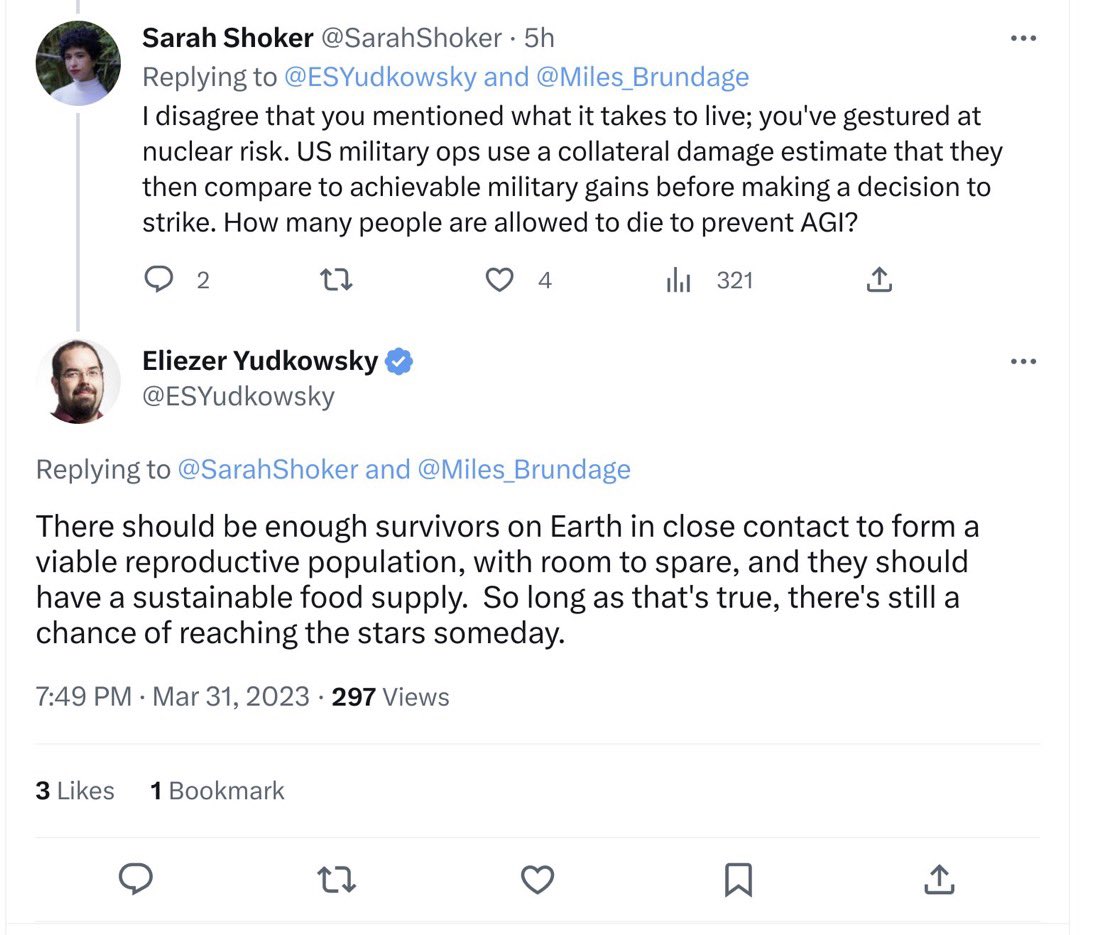
The fact that North Dakota has a lot more influence in the US Senate than California on a per capita basis shouldn't be that big of a deal, because the US Senate should be doing a whole heck of a lot less than it is, and states should be picking up that slack.
The more power and responsibility we have given the federal government, the more the issues appear....because it's doing things never intended or envisioned by the founders.
reply